Congratulations to Antigone Michael: recipient of a Jason O’Brien travel bursary, 2026
We are delighted to be able to continue to offer a total of eight bursaries to student researchers this year, all generously funded by friends and supporters of the Institute. We will be sharing news about their projects over the summer.
First up, warmest congratulations to Antigone Micheal who is a doctoral student in the Department of Classics, Trinity College Dublin, and the holder of one of our Jason O’Brien travel bursaries this year.
Her doctoral project, "Echoes of the Ottoman Empire: Protecting Cultural Heritage in Conflict and Post-Conflict Zones of Southeast Europe", explores the interrelationship between conflict, cultural heritage, peace, and the public across Bosnia and Herzegovina, Cyprus, and Palestine, and it is supported by a Taighde Éireann - Research Ireland Scholarship.
During her time in Athens recently, she convened a meeting at the Institute, which she shares a short report on below:
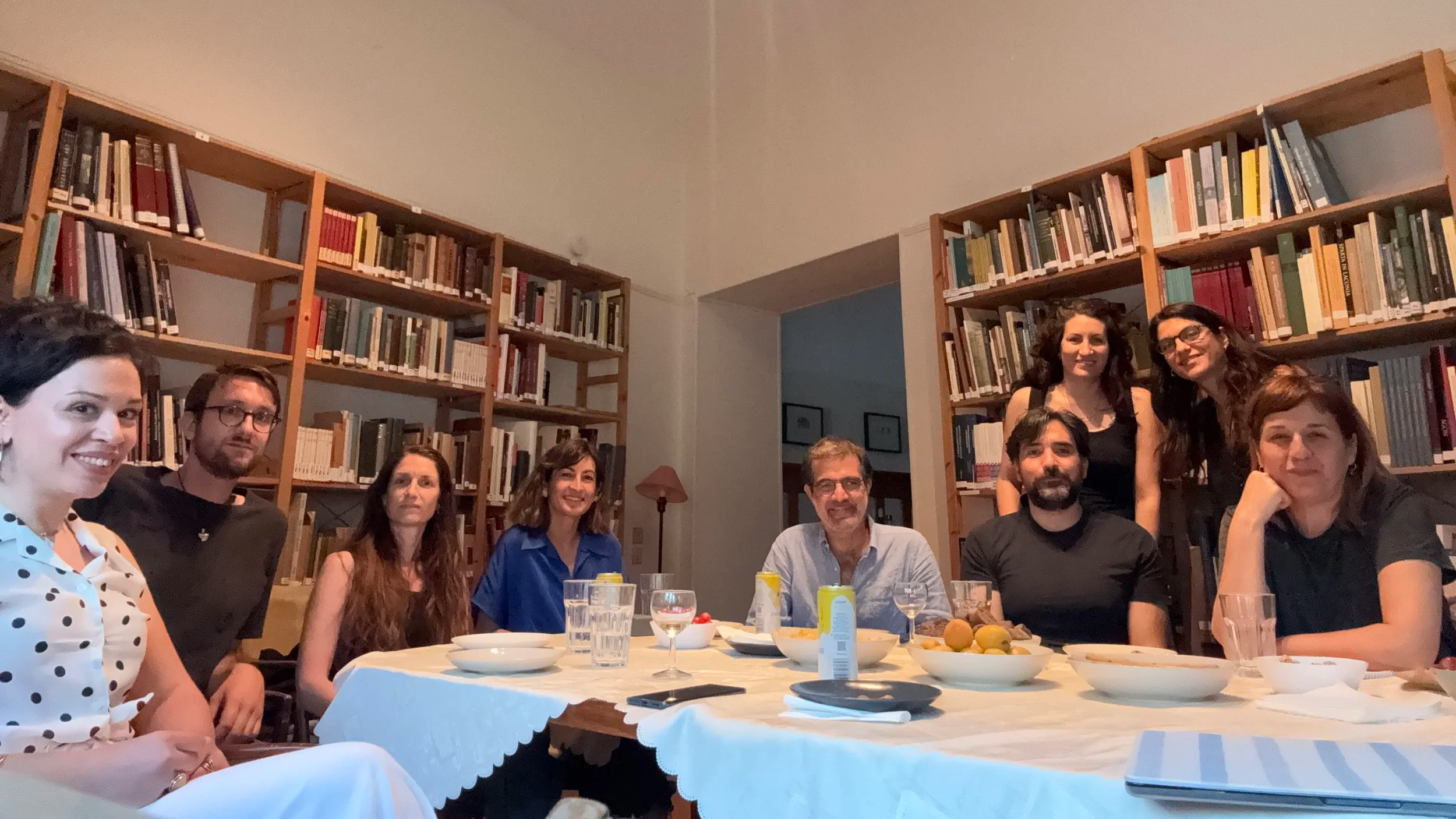
On 30 June 2026, the Irish Institute of Hellenic Studies in Athens hosted an interdisciplinary expert gathering organised by Antigoni Michael. The event brought together specialists from archaeology, history, architecture, cultural theory, photography, and heritage practice to discuss the political dimensions of cultural heritage in the Eastern Mediterranean.
The meeting aimed to create an informal space for interdisciplinary dialogue, encouraging participants to reflect on the relationship between archaeology, heritage, and contemporary society. Particular attention was given to the ways political, social, and economic frameworks influence decision-making in archaeological research, heritage preservation, public narratives, and community participation.
The discussion brought together Dr Antonis Hatjikyriakou (Panteion University), Dr Despina Catapoti (University of the Aegean), Dr Kiriaki Tsirtsi (American School of Classical Studies), Dr Marilena Pateraki (Irish Institute of Hellenic Studies in Athens), Stefano Ruzza (La Sapienza University of Rome and the National and Kapodistrian University of Athens), Dr Stavroula Thravalou (Elliniki Etairia for the Environment and Culture), Dr Stelios Lekakis (Ionian University), Nelly Ollivault, and Antigoni Michael.
The conversation explored a wide range of interconnected themes, including contested memories, heritage destruction, accessibility, the politics of preservation, and the responsibilities of scholars in engaging with contemporary societies. Participants reflected on examples from Cyprus, Greece, Turkey, and the wider Eastern Mediterranean, highlighting how heritage is shaped by political agendas, economic interests, and changing social values. The discussion also considered the effects of climate change, digital technologies, and tourism on heritage management, alongside the importance of communicating archaeological knowledge in ways that are accessible and meaningful to diverse communities.
A recurring theme throughout the evening was the need to move beyond disciplinary and administrative boundaries in the study and management of cultural heritage. Participants stressed that archaeology should be understood not only through categories of monuments or artefacts, but as part of wider social, political, and environmental systems. The discussion also highlighted the importance of recognising local communities as active stakeholders in heritage processes and of developing more inclusive approaches to interpretation, preservation, and decision-making.
The gathering concluded with a shared commitment to strengthening interdisciplinary collaboration and expanding dialogue between researchers, heritage professionals, and civil society. Participants agreed that such exchanges are essential for understanding the role of archaeology and cultural heritage in contemporary societies and for promoting more equitable and socially engaged heritage practices.