
IIHSA Events
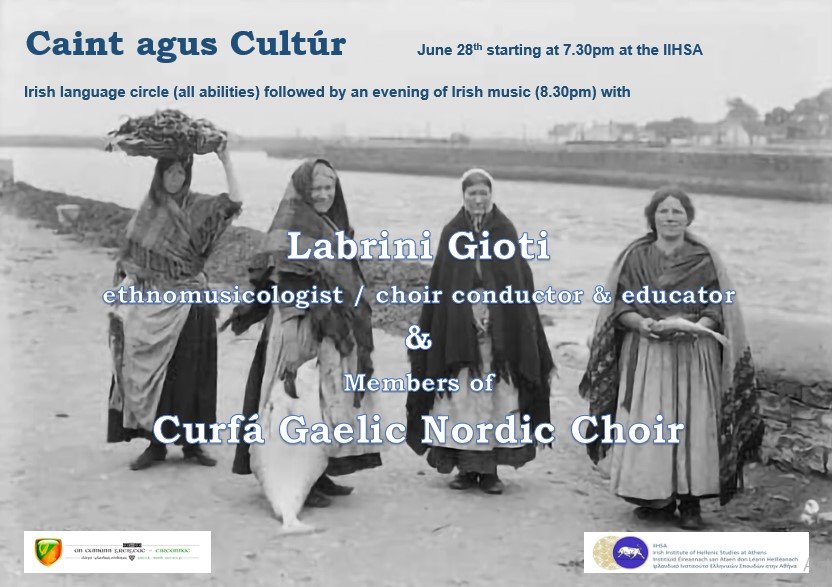
Ciorcal comhrá (Irish-language circle) & Lambrini Gioti and the Curfá Gaelic Nordic Choir, introduction to the Sean-nós Tradition
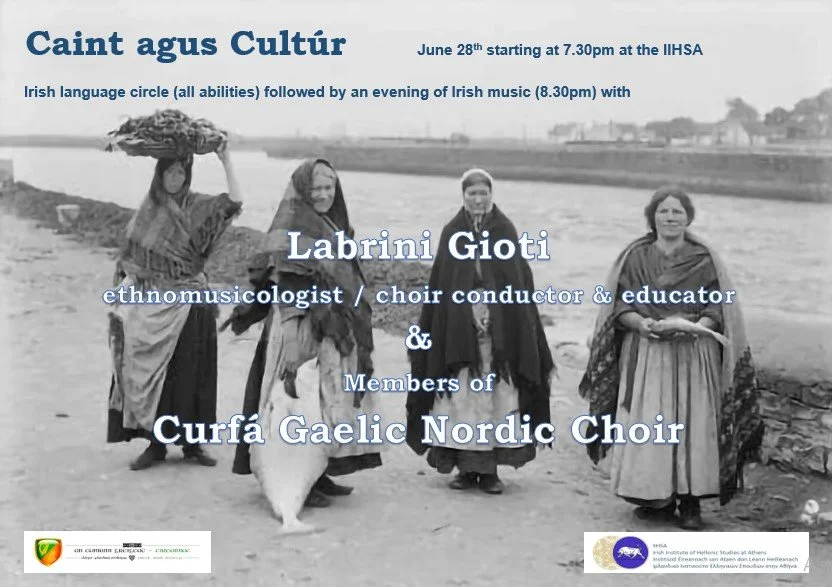
We are delighted to invite you to the next (3rd) session of our Caint agus Cultúr initiative, organised in collaboration with the Greek-Irish Society.
Continuing the initiative’s two-part format, the evening will begin with our monthly Ciorcal Comhrá, an Irish-language conversation circle and informal class designed to encourage spoken Irish in a relaxed, friendly, and welcoming environment. Participants of all levels are warmly welcome, including complete beginners with no prior knowledge of the language.
For the second part of the evening, we are delighted to welcome Lambrini Gioti and the Curfá Gaelic Nordic Choir, who will introduce us to the history and beauty of Sean-nós singing (one of Ireland’s most distinctive musical traditions), and perform a selection of songs on our rooftop under the summer night sky. For those feeling adventurous, some of the song lyrics will be taught during the Ciorcal, offering the opportunity to join in later in the evening!
As always, it will take place at the premises of the Irish Institute of Hellenic Studies at Athens (Agras 23, Pangrati):
Ciorcal Comhrá: 19:30
Introduction to the Sean-nós Tradition: 20:30
Choir Performance: 21:00
You are very welcome to attend either part of the evening - or both!
Please note that registration is required. To reserve your place, kindly email: irishinstitutegr@gmail.com
This will be our final Caint agus Cultúr session before the summer break. We look forward to returning in the autumn with a new programme of events.
We hope to celebrate the start of summer with many of you! ~ Tá súil againn go mbeidh go leor agaibh linn chun tús an tsamhraidh a cheiliúradh!
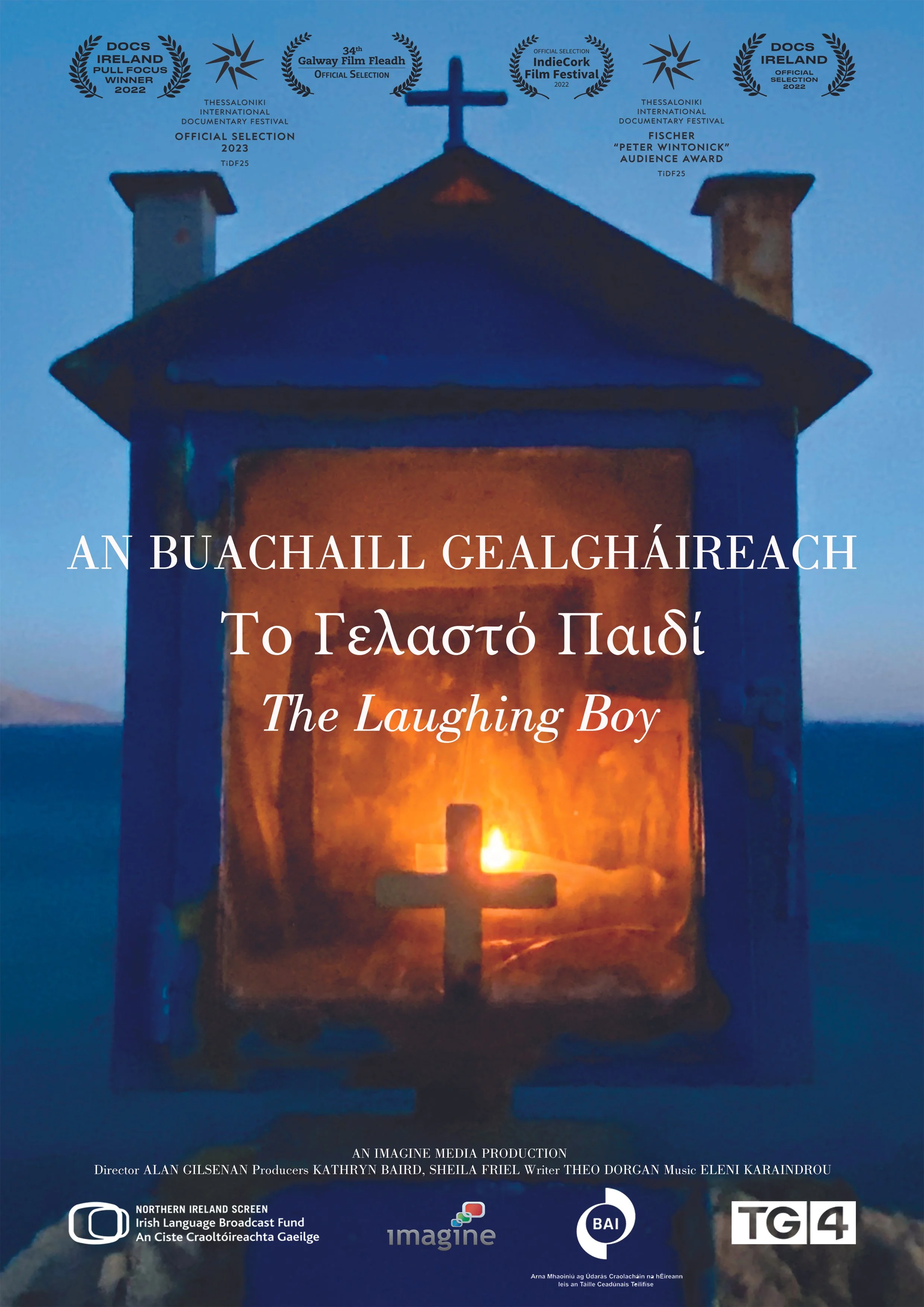
Ciorcal comhrá (Irish-language circle) & screening of An Buachaill Geal Gáireach / The Laughing Boy / Το γελαστό παιδί
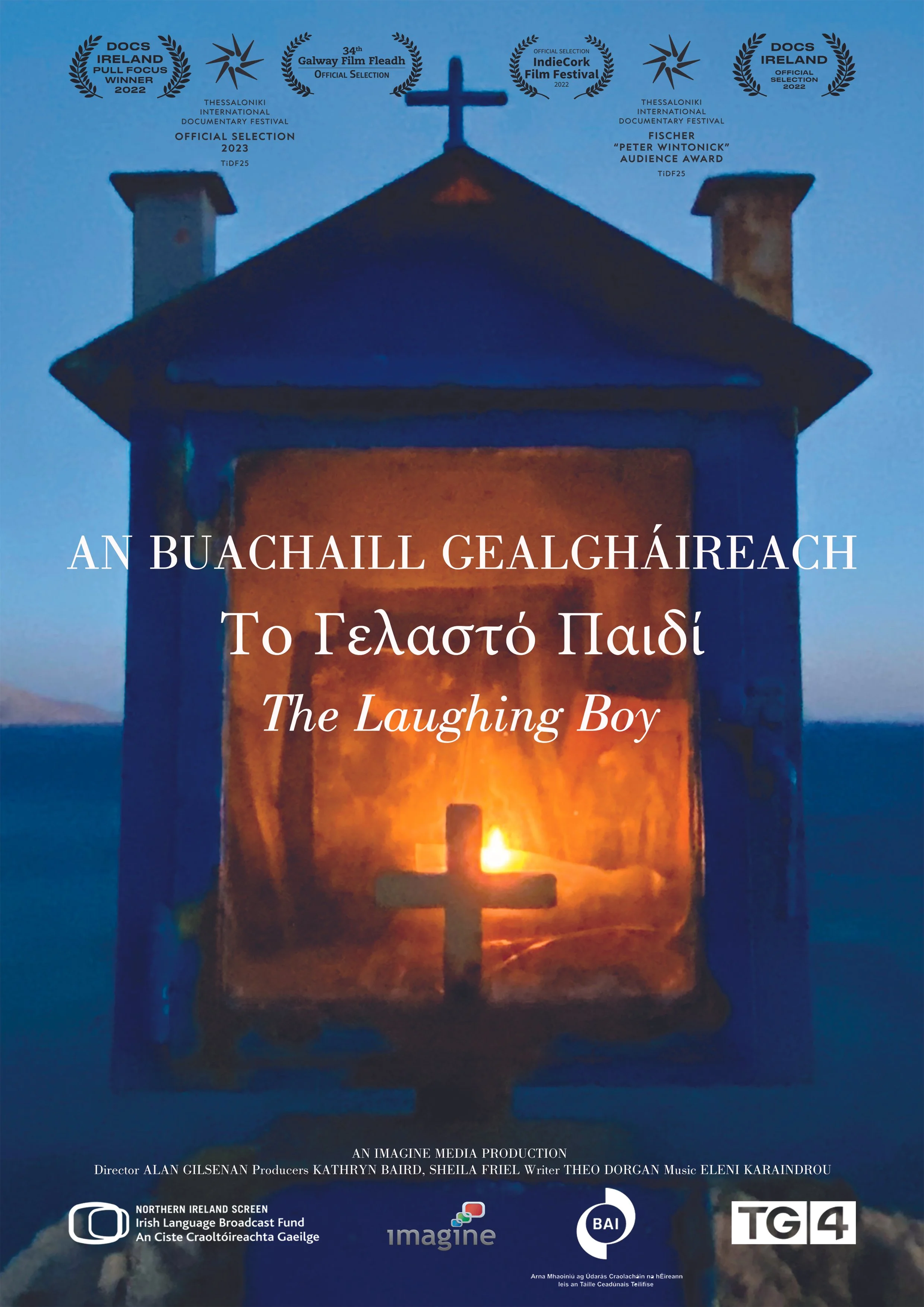
We are delighted to invite you to the next session of our Caint agus Cultúr initiative, organised in collaboration with the Greek-Irish Society.
Continuing the initiative’s two-part format, the evening will begin with our monthly Ciorcal Comhrá, an Irish-language conversation circle and informal class designed to encourage spoken Irish in a relaxed, friendly, and welcoming environment. Participants of all levels are warmly welcome, including complete beginners with no prior knowledge of the language.
The second part of the evening will feature a screening of An Buachaill Geal Gáireach / The Laughing Boy / Το γελαστό παιδί, the acclaimed trilingual documentary by director Alan Gilsenan, which traces the remarkable journey of Brendan Behan’s poem of the same title. Written by the teenage rebel in memory of Michael Collins, and set to music in 1961 by the celebrated Greek composer Mikis Theodorakis, the poem took on an extraordinary second life as a symbol of resistance and liberation during the turbulent political decades of 1960s and 1970s Greece. Part historical exploration, part cultural odyssey, the film follows poet Theo Dorgan as he uncovers the intertwined histories of modern Ireland and modern Greece through the story of a single song.
The film has been screened at numerous international festivals in Ireland and abroad.
(Please note that, due to the Greek-Irish Society’s Annual Meeting on 24 May, this session will exceptionally be held on Saturday, 23 May 2026.)
As always, it will take place at the premises of the Irish Institute of Hellenic Studies at Athens (Agras 23, Pangrati):
· Ciorcal Comhrá: 18:00
· Film Screening: 19:00 (Film duration: 1h 34 mins)
You are very welcome to attend either part of the evening - or both!
Please note that registration is required. To reserve your place, kindly email: irishinstitutegr@gmail.com
We look forward to welcoming you! - Táimid ag súil le sibh a fheiceáil ann!
For in-person attendance, please register via email: irishinstitutegr@gmail.com
For online participation, please register here:
https://us06web.zoom.us/meeting/register/ABByH1ObQAGpIZSQrtAzaw
We look forward to welcoming you! ~ Táimid ag súil le sibh a fheiceáil ann!
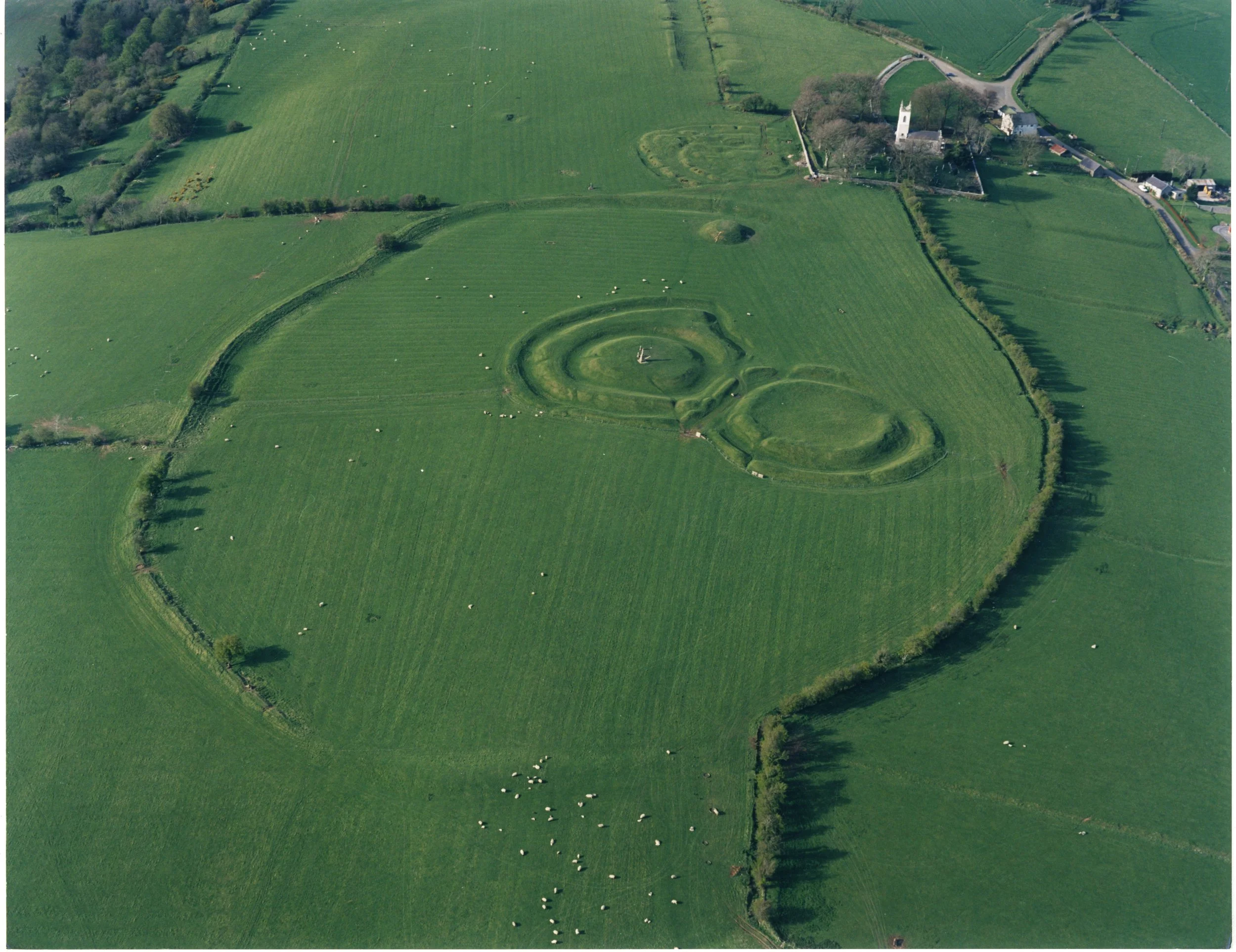
‘Layers of Ireland’ series, Muiris O’Sullivan, The hill of Tara, Ireland: Myths, Monuments and Identities
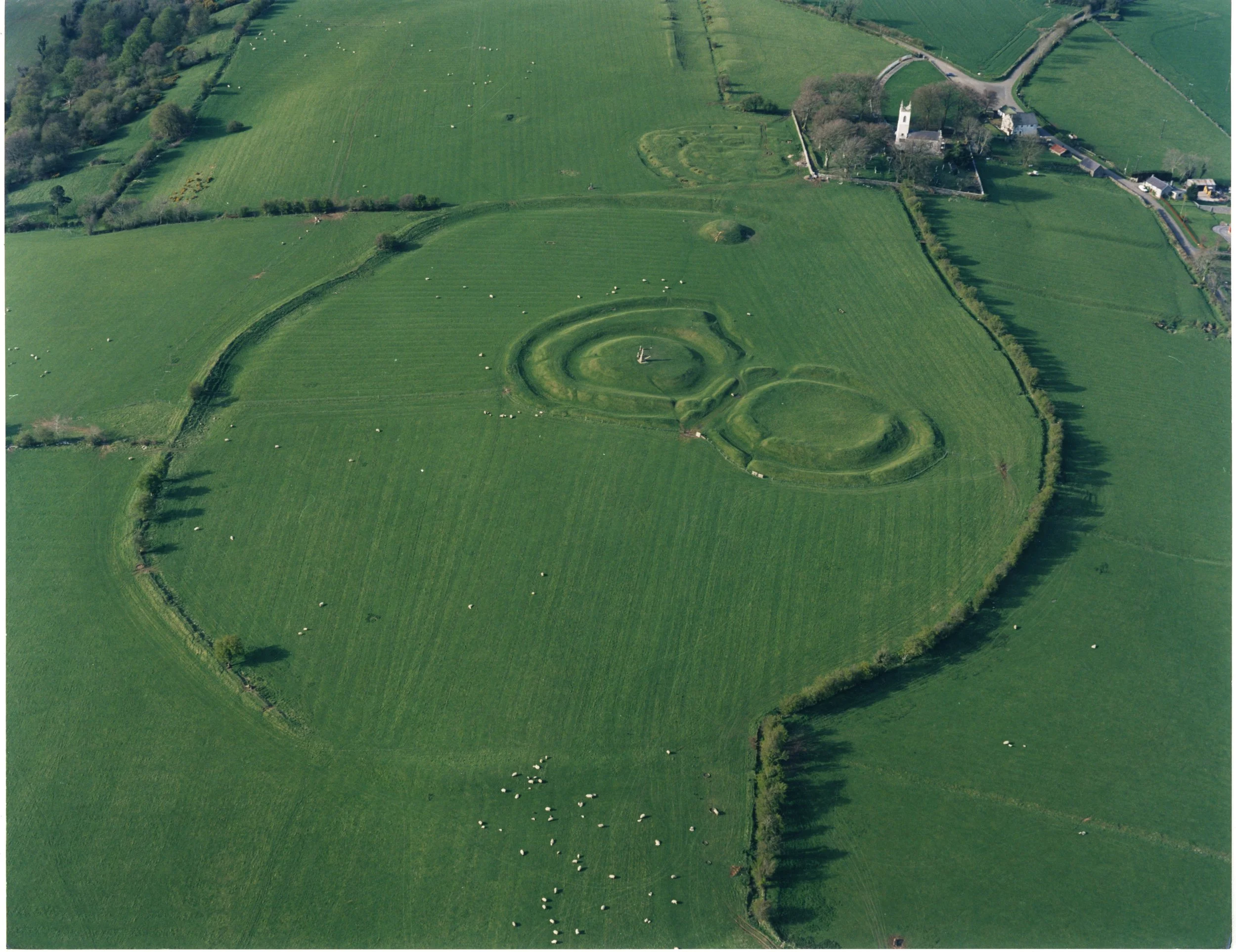
You are invited to a public lecture in our ‘Layers of Ireland’ series on Thursday May 21st, 2026 at 19.00 pm (Greece time), 17.00 pm (Ireland time), 12.00 pm (EST). Our speaker is Professor Muiris O’Sullivan (Emeritus Professor of Archaeology, University College Dublin), on ‘The hill of Tara, Ireland: Myths, Monuments and Identities’.
Abstract: In his IIHSA lecture, Muiris O’Sullivan will explore some overlapping strands of Tara’s mythology, history and archaeology. Unlike the UNESCO World Heritage Site at Brú na Bóinne, there are no imposing stone monuments on the Hill of Tara. Again, unlike the precarious clifftop locations at Skellig Michael and Dún Aenghusa, the Tara landscape is not especially stunning. What sets Tara apart is its significance as a representation of Irish identity. For more than 5,000 years, this place seems to have encapsulated the soul of Ireland in a unique way. It has been mythologised from before the dawn of history and continues to be infused with myth down to the present day. Only a tiny portion of the hill has been excavated by archaeologists, but the results of these excavations suggest that Tara has a story to tell that is as remarkable as the myths it has inspired.
Biographical notes: Muiris O’Sullivan is Emeritus Professor of Archaeology at University College Dublin.
In the 1980s, he participated in the excavations at Knowth in the Boyne Valley and was awarded a PhD for his thesis on megalithic art. He was then invited to examine the unpublished archive from three seasons of archaeological excavations in the 1950s at the Mound of the Hostages on the Hill of Tara. This monument, a Neolithic passage tomb overlain by a Bronze Age cemetery mound, had yielded spectacular results, but had remained unpublished. In due course, he completed this project with a much-cited volume, The Mound of the Hostages, Tara (O’Sullivan 2005) and he subsequently organised the publication of a follow-up volume on the previously unpublished excavations at an adjacent Iron Age enclosure, The Rath of the Synods (Grogan 2008). He then organised an international symposium dealing with Tara, resulting in the multi-author review volume, Tara – From the Past top the Future (O’Sullivan et al (eds) 2013).
Side by side with this research, he ran his own multi-season excavation at Knockroe, county Kilkenny, the outcome of which brought a previously anonymous passage tomb monument to national and international attention, not least for its solar alignments and significant assemblage of decorated stones. More recently, he was the lead archaeological consultant for the updated visitor experience at the Brú na Bóinne UNESCO World Heritage Site, opened in 2019, and he served on the international scientific committee of Paysages de Mégalithes, the successful proposal of the megaliths in the Carnac and surrounding coastal region in Brittany, France, for UNESCO World Heritage Site listing.
In addition to an extensive list of book chapters, papers in academic journals and contributions to international conference proceedings, he has written or co-written more than a hundred articles for the journal Archaeology Ireland. He is lead author of the influential report Archaeological Features at Risk (Heritage Council,1998) and Antiquities of Rural Ireland (Wordwell, 2018). He is also co-author of Cottage Industry in Post-Medieval Ireland (Wordwell, 2024) and the foresight study Archaeology 2020 (Heritage Council, 2006).
Professor O’Sullivan is a former head of the UCD School of Archaeology. He was a member of the Heritage Council from 2016 to 2020 and led the preparation of Heritage at the Heart: Heritage Council Strategy 2018-2022.
“Sharing Ancient Irish Heritage with the Irish Diaspora in Greece” is a series of open public lectures on Irish archaeology, taking place throughout May 2026 under the overarching theme “Layers of Ireland” with the support of the Government of Ireland Emigrant Support Programme.
Further information: To attend in person, please register by email: irishinstitutegr@gmail.com
Register for online attendance: https://us06web.zoom.us/meeting/register/puqQPb3BR6Gk8DXoVlbdtw
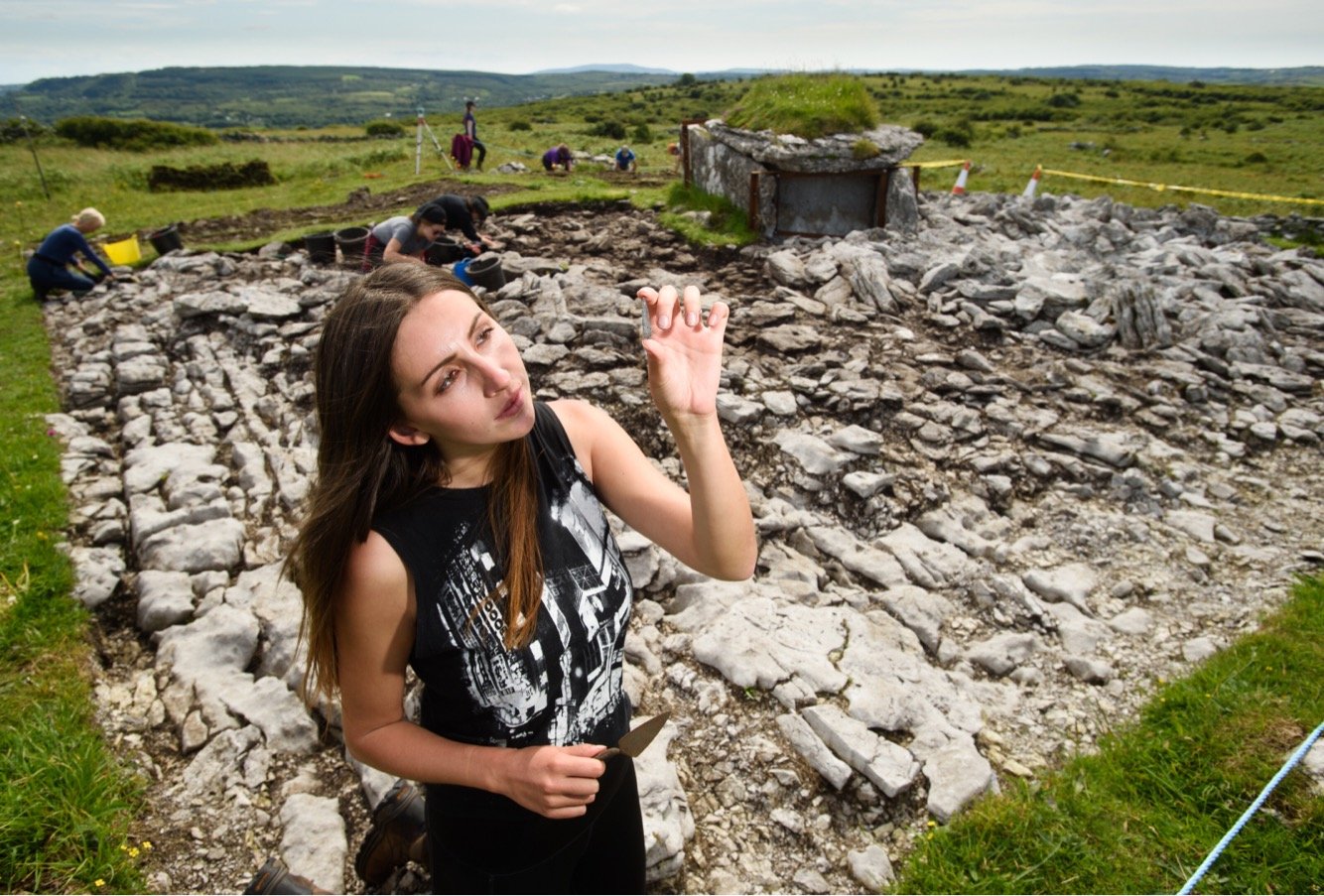
‘Layers of Ireland’ series, Dr Ros Ó Maoldúin, Treasures of the Burren: Prehistoric Tombs and Ancient DNA
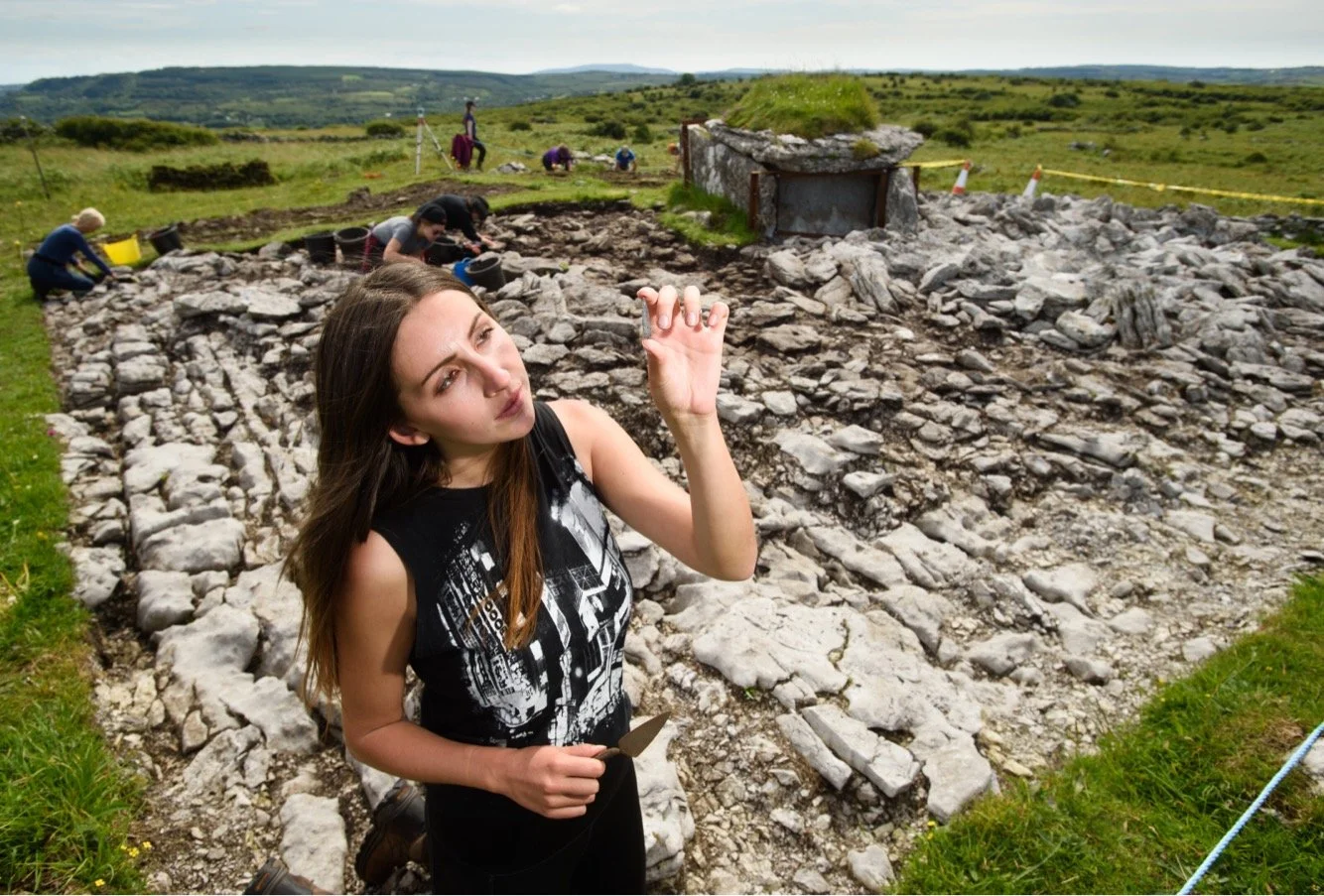
You are invited to a public lecture in our ‘Layers of Ireland’ series on Thursday May 14th, 2026 at 19.00 pm (Greece time), 17.00 pm (Ireland time), 12.00 pm (EST). Our speaker is Dr Ros Ó Maoldúin (Institute of Archaeologists of Ireland), on ‘Treasures of the Burren: Prehistoric Tombs and Ancient DNA.’
Abstract
Few landscapes in Ireland hold as many secrets as the Burren. In this talk, Dr Ó Maoldúin takes us on a vivid journey through one of Europe's most remarkable prehistoric landscapes - a vast limestone karst on Ireland's Wild Atlantic coast, where archaeological remains have survived for thousands of years.
The Burren's particular geology has earned it UNESCO Geopark status — but on its iconic limestone pavements there also lies an archaeological treasure trove of megalithic tombs and settlement traces. The same stone that shaped this landscape also preserved the bones of the people who lived on it, with profound implications for modern science. Human remains recovered here are among the best-preserved in Ireland and researchers have successfully extracted ancient DNA from these bones, opening a remarkable window onto the lives, movements,and relationships of people who lived here thousands of years ago.
Dr O Maoldúin brings this story to life through his own excavations: three Chalcolithic megalithic tombs, a barrow, and several prehistoric hut sites, all uncovered in this extraordinary landscape. Illustrated with photographs from the field, this talk offers a first-hand account of discovery at the intersection of archaeology and cutting-edge genetic science.
“Sharing Ancient Irish Heritage with the Irish Diaspora in Greece” is a series of open public lectures on Irish archaeology, taking place throughout May 2026 under the overarching theme “Layers of Ireland” with the support of the Government of Ireland Emigrant Support Programme.
Further information:
To attend in person, register by email: irishinstituegr@gmail.com
For online attendance, please register: https://uso6web.zoom.us/meeting/register/HZd_LLAWTxmzMZ8vD|62QA
For online attendance please register here:
https://us06web.zoom.us/meeting/register/jASQ5mZBS0O29Sw9E2DDSw
To attend in person, please register by email: irishinstitutegr@gmail.com
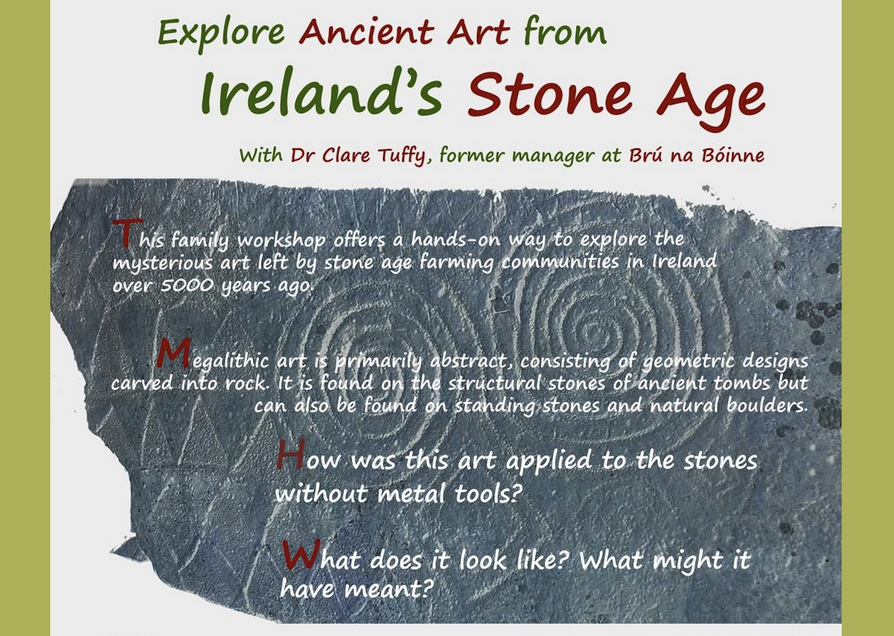
‘Layers of Ireland’ series, Family workshop: explore ancient art from ireland’s stone age
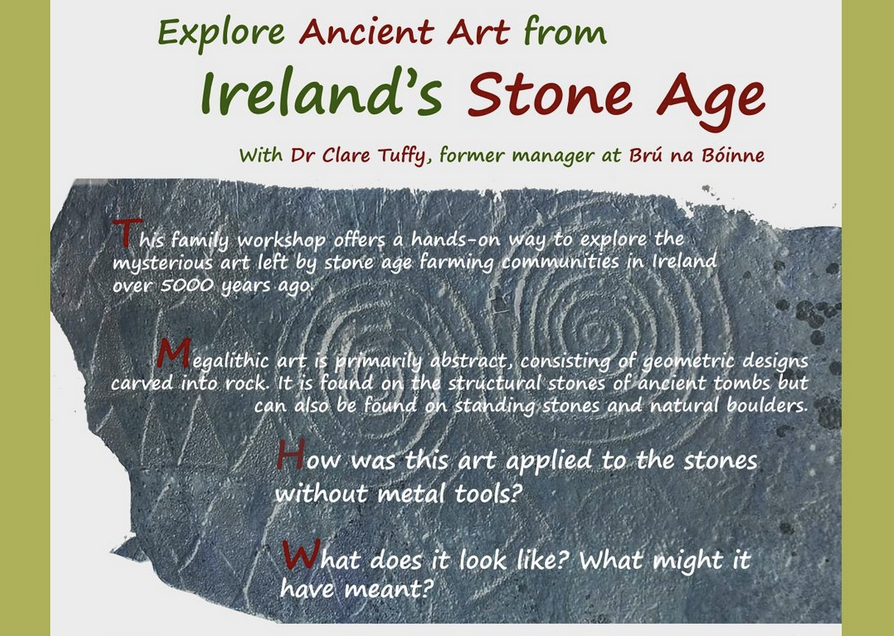
Dr Clare Tuffy will lead a hands-on workshop on Stone Age megalithic art. Explore ancient symbols and patterns through interactive activities designed for all ages.
Workshop activities
• Discover ancient art from Ireland's best known prehistoric sites
• Use your imagination to decorate a tomb with megalithic desings
• Try your hand at stone age maths
• Get a realistic temporary tattoo incorporating Neolithic designs! (safe, non-toxic and pain free)
• Learn a traditional Irish children's song at the end
“Sharing Ancient Irish Heritage with the Irish Diaspora in Greece” is a series of open public lectures on Irish archaeology, taking place throughout May 2026 under the overarching theme “Layers of Ireland” with the support of the Government of Ireland Emigrant Support Programme.
Further information: To register your place: irishinstituegr@gmail.com
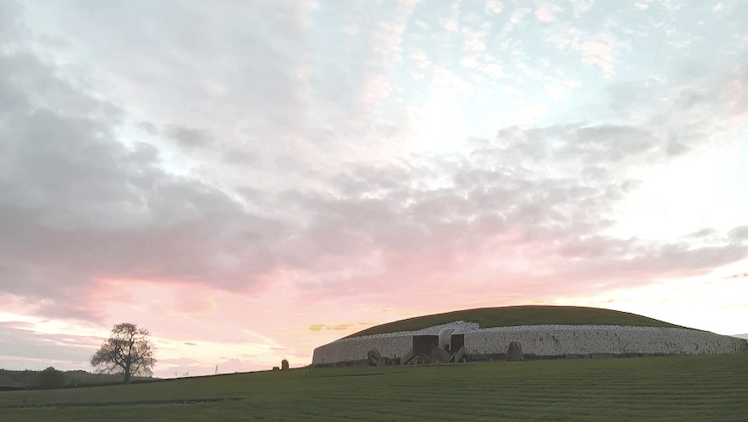
‘Layers of Ireland’ series, Dr Clare Tuffy, ‘The Archaeology of the boyne valley’
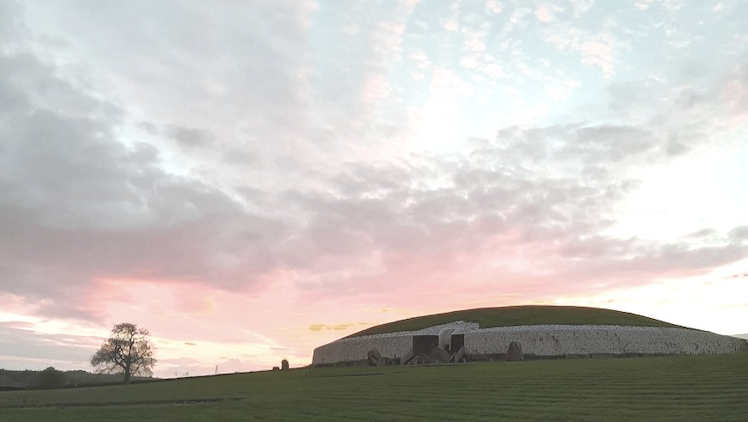
You are invited to a public lecture in our ‘Layers of Ireland’ series on Thursday May 7th, 2026 at 19.00 pm (Greece time), 17.00 pm (Ireland time), 12.00 pm (EST). Our speaker is Dr Clare Tuffy (former Manager at Brú na Bóinne), on ‘The Archaeology of the Boyne Valley’.
Abstract
The Boyne Valley was Ireland's ancient capital and its most sacred and mythical landscape. Over nearly six millennia, the story of Ireland has been written along the banks of the river Boyne. This presentation explores ancient tombs and royal sites, early Christian monasteries, a vast Anglo Norman Castle and a fierce battle that changed the course of European history.
“Sharing Ancient Irish Heritage with the Irish Diaspora in Greece” is a series of open public lectures on Irish archaeology, taking place throughout May 2026 under the overarching theme “Layers of Ireland” with the support of the Government of Ireland Emigrant Support Programme.
Further information:
To attend in person, register by email: irishinstitutegr@gmail.com
For online attendance, register here: https://us06web.zoom.us/meeting/register/Qlr7L4OcSp60hk2nftlrmQ
“Sharing Ancient Irish Heritage with the Irish Diaspora in Greece”: A series of public lectures on Irish archaeology during May 2026.
We are very pleased to share the next chapter of our initiative, “Sharing Ancient Irish Heritage with the Irish Diaspora in Greece”: a series of open public lectures on Irish archaeology, taking place throughout May 2026 under the overarching theme “Layers of Ireland.
As we move closer to each event, further details will be announced. Alongside the lectures, the series will include additional activities for both adults and children
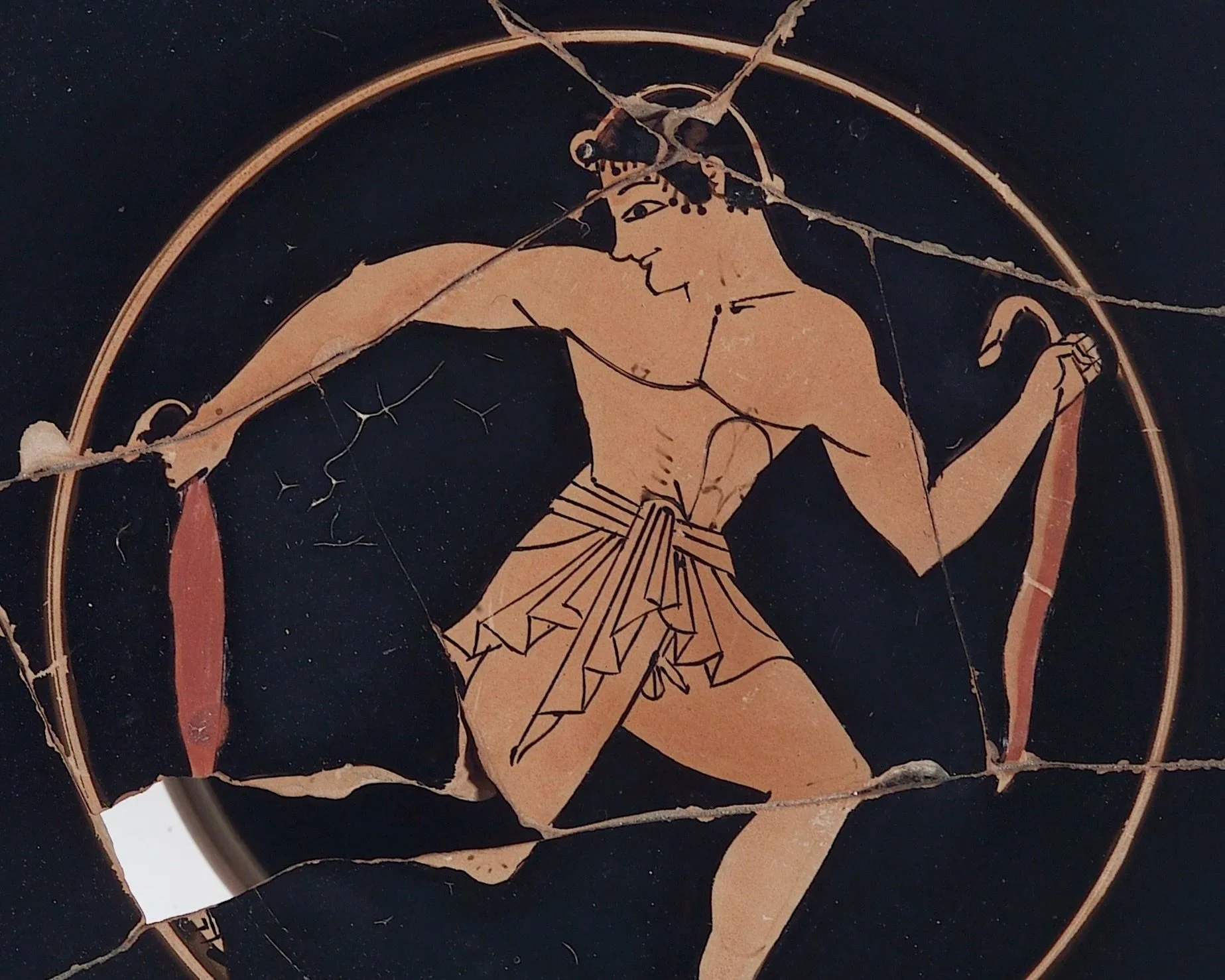
Seminar Series, Domestic Life in the Ancient World: Kathleen Lynch, "No Plates or Bowls in the Cupboard: How did Archaic and Classical Athenians Set their Table"
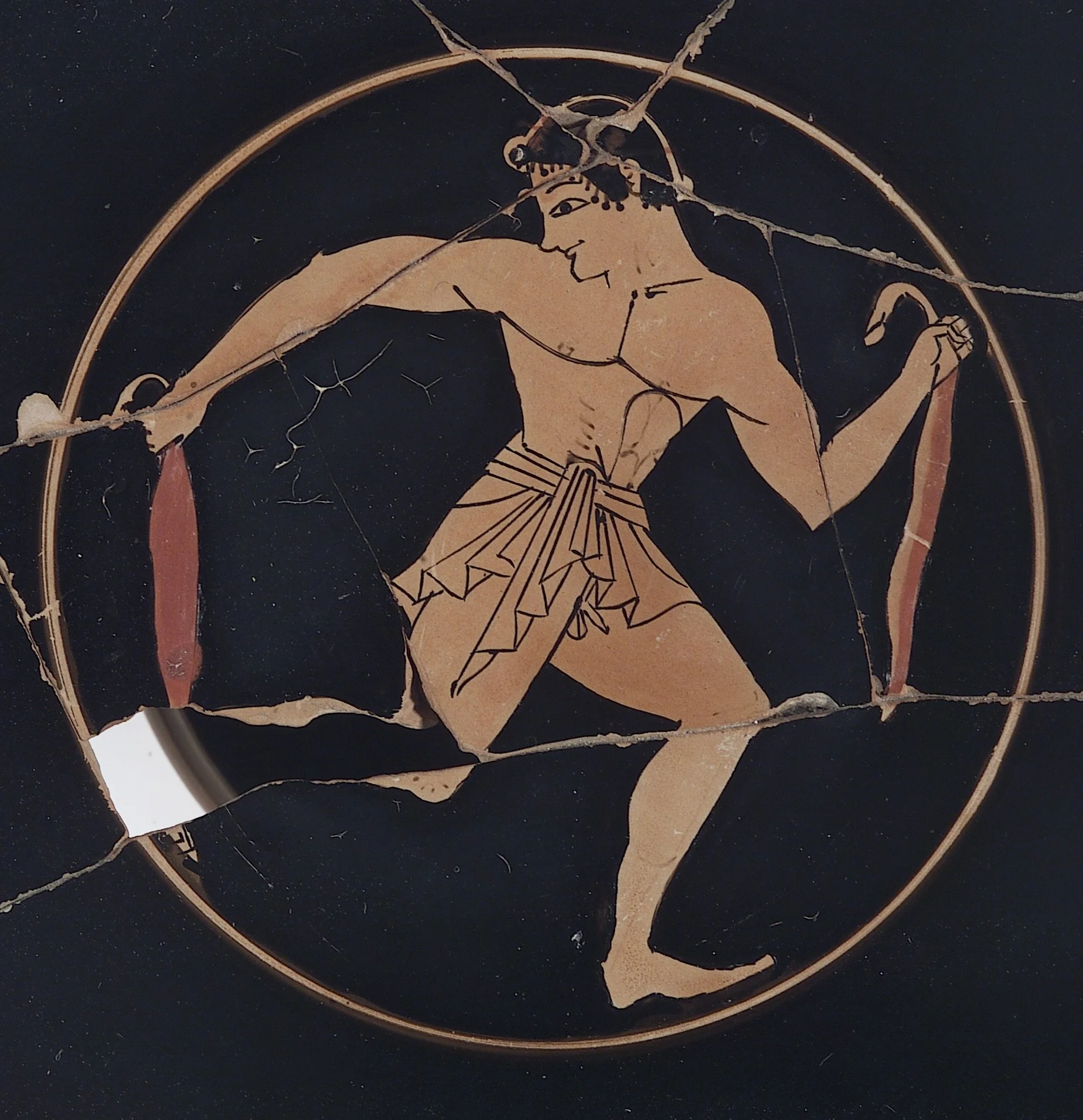
You are invited to our 2025-26 Seminar series on ‘Domestic Life in the Ancient World’. This will be an hybrid event on Monday April 27th, 2026 at 19.00 pm (Greece time), 17.00 pm (Ireland time), 12.00 pm (EST), by Professor Kathleen Lynch (Professor of Classical Archaeology, University of Cincinnati), on "No Plates or Bowls in the Cupboard: How did Archaic and Classical Athenians Set their Table".
Abstract
Athenian potters of the Archaic and early Classical periods produced extraordinary ceramic vessels, often decorated with figures, to facilitate the symposium, the communal wine-drinking activity. In contrast, they did not produce dishes and bowls for food consumption. This talk will explore this conundrum: we know ancient Athenians ate food - we have their cooking pots - but why did the potters not create equally complex sets of pottery for food consumption as they did wine consumption? The contrast being eating and drinking wine illuminates the importance of wine in cultural definition and may reflect and unusual confidence in the food supply.
Further information:
The IIHSA Seminar Series for 2025–2026 will explore various aspects of household life in the ancient world, including labour and production, gender roles, childhood, food practices, and broader issues of social structure and negotiation across different periods and regions. Designed for graduate students and anyone interested in engaging deeply with a topic beyond the traditional lecture format, the series offers participants an opportunity to discuss and exchange ideas directly with experts in the field. Each seminar features a 30–40 minute presentation followed by an open discussion, co-led by the Assistant Director, to encourage active participation and dialogue. A brief bibliography is provided for those who wish to familiarize themselves with the seminar topic.
Bibliography
Douglas, Mary. 1997 [1972]. "Deciphering a Meal." In Food and Culture: A Reader, edited by C. Counihan and P. Van Esterik, 2° edition, 36-54.
Hastorf, Christine A. 2017. The Social Archaeology of Food: Thinking about Eating from Prehistory to the Present, Cambridge.
Lynch, K. M. 2011. The Symposium in Context: Pottery from a Late Archaic House near the Athenian Agora, Hesperia Supplement 46, Princeton, N.J.
Lynch, K. M. 2015. "Drinking Cups and the Symposium at Athens in the Archaic and Classical Periods," in Cities Called Athens, ed. K. Daly and L. Ricardi, Lewisburg, PA, pp. 231-271.
For online attendance please register here:
https://us06web.zoom.us/meeting/register/jASQ5mZBS0O29Sw9E2DDSw
To attend in person, please register by email: irishinstitutegr@gmail.com
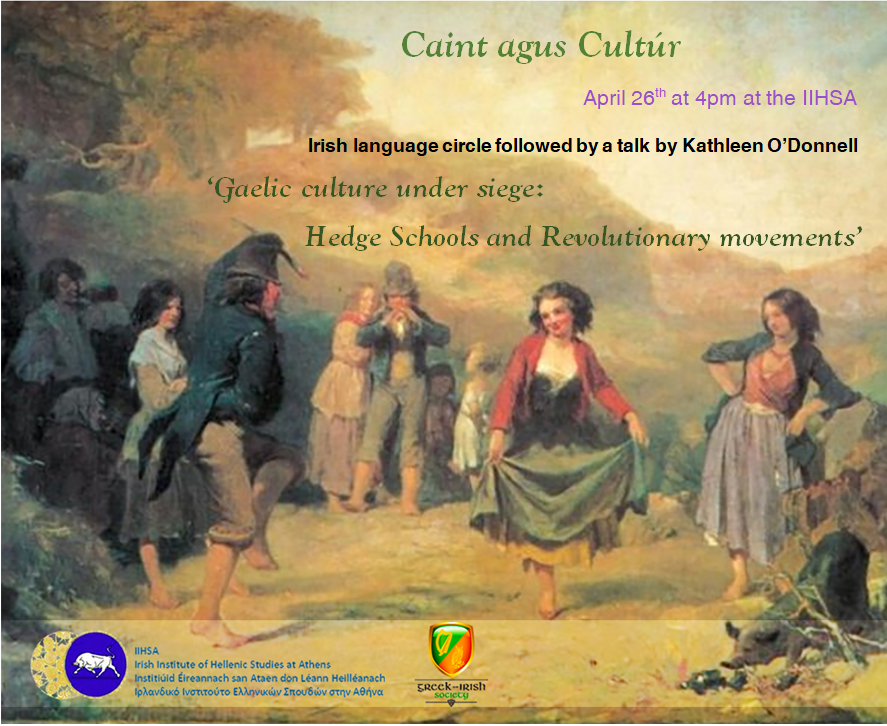
Ciorcal comhrá (Irish-language circle)& lecture, Kathleen O'Donnell, “Gaelic Culture under Siege: Hedge Schools and Revolutionary Movements”
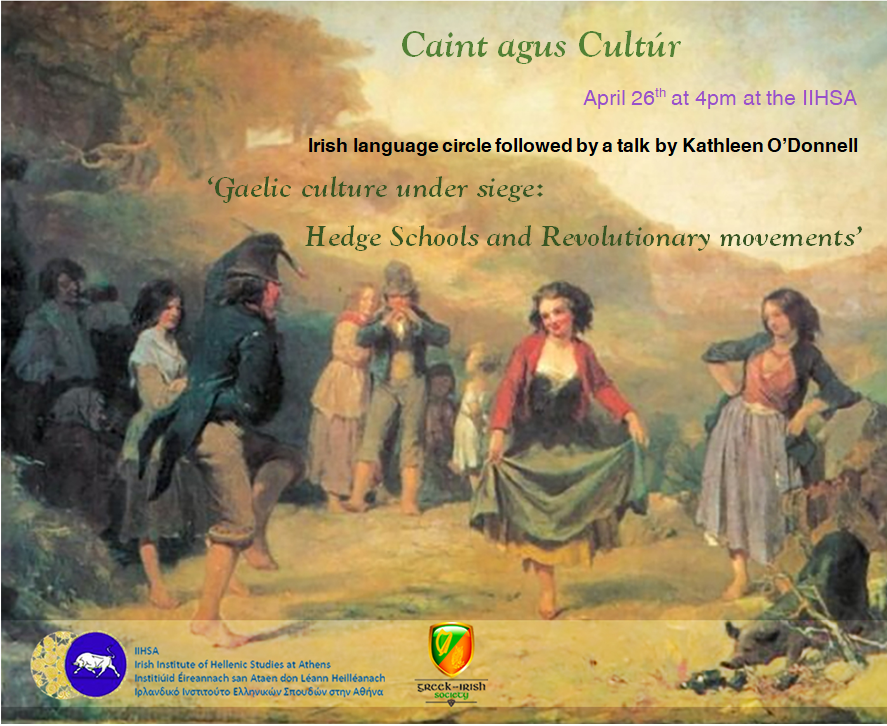
We are delighted to announce a new initiative developed in collaboration with the Greek-Irish Society, dedicated to the promotion of Irish language and culture.
Entitled Caint agus Cultúr (Speech and Culture), this project will feature a monthly Ciorcal comhrá (Irish-language conversation circle and class), offering participants the opportunity to engage in conversational Irish in a relaxed and welcoming environment. Each session will be followed by a lecture, film screening, or other cultural event related to Ireland.
Participants are welcome to attend either part of the programme or the full session. All levels are welcome, including beginners with no prior knowledge of Irish.
The series will commence on Sunday, 26 April 2026, with the following schedule:
• 16:00 – Ciorcal comhrá
• 17:00 – Lecture by Kathleen O'Donnell, independent scholar: “Gaelic Culture under Siege: Hedge Schools and Revolutionary Movements” (delivered both in person and online)
For in-person attendance, please register via email: irishinstitutegr@gmail.com
For online participation, please register here:
https://us06web.zoom.us/meeting/register/ABByH1ObQAGpIZSQrtAzaw
We look forward to welcoming you! ~ Táimid ag súil le sibh a fheiceáil ann!
The Elements: IIHSA Dublin day School 2026
We invite you to join us for our 2026 Dublin Day School, on the theme of The Elements, and hosted this year at University College Dublin on Saturday April 11th from 1 - 4.30 pm. The event will be hybrid with the option to attend in person or via Zoom.
The Elements are universal subjects of interest from ancient writers to scientific archaeological analyses today. Presentations at this event will engage with this from a range of perspectives over five papers.
Programme
13h: Welcome
13.15: Brendan O'Neill (UCD Archaeology)
Forged in Fire: experimenting with hot technologies
13-45: Sasha Smith (UCD Classics)
Leave no stone unturned: The search for Sir George Cockburn's Antiquities
14.15: Barry Molloy (UCD Archaeology)
It's Element-ary Dr Watson: Investigating human mobility in Neolithic Crete using stable isotopes
14-45: Coffee Break
15.15: Samantha Martin (UCD Architecture)
Gimme Shelter: Architecture and the Elements in Athens
15.45: William Megarry (QUB Archaeology)
Staying Safe from the Elements: Climate Change, Culture and Curating a Future for our Past
16.15: Discussion
16.30: Reception, kindly sponsored by Odaios Foods, to follow
Location: The Barry Raftery Seminar Room, Ardmore Annex, UCD School of Archaeology, University College Dublin.
For in-person attendance, please book your place here with Eventbrite
To attend online, join on Zoom: https://ucd-ie.zoom.us/j/63761802630?pwd=zTylGcgZqdvm6ZAXAC6ZX0pxUxn2pI.1&jst=2
Seminar Series, Domestic Life in the Ancient World: Kostas Kopanias, "Gender at Home and Before the Law: Domestic Roles in Hittite Legal Texts and the Homeric Epic Tradition."
You are invited to our 2025-26 Seminar series on ‘Domestic Life in the Ancient World’. This will be an hybrid event on Thursday 2nd April, 2026 at 19.00 pm (Greece time), 17.00 pm (Ireland time), 12.00 pm (EST), by Professor Kostas Kopanias (Professor in the Archaeology of Anatolia and the Near East, National Kapodistrian University of Athens) on “Gender at Home and Before the Law: Domestic Roles in Hittite Legal Texts and the Homeric Epic Tradition."
Abstract
This talk explores how gender roles are defined in Hittite law, with a focus on family life and everyday social relations. It examines rules on marriage, divorce, inheritance, work, and sexual behaviour in order to show how men and women were positioned within the household and before the law. The evidence presents a nuanced picture. In some areas, such as homicide and bodily injury, men and women are treated in similar ways. In others, especially in labour and family matters, clear differences appear. The talk also highlights the importance of financial compensation as a central tool for resolving conflicts. Payments are used not only for economic matters but also for regulating social relationships, including marriage and its breakdown. Special attention will be given to how the law handles issues such as adultery, sexual offences, and mixed marriages between free persons and slaves. These cases reveal how responsibility is assigned and how the legal system balances control with a certain degree of flexibility. The role of the household, the authority of the husband, and the position of women within this structure will be discussed through specific examples from the texts. Overall, the talk shows that Hittite law reflects a society shaped by hierarchy and status, but also by practical solutions aimed at maintaining order and stability. Gender is an important factor, but it operates within a broader framework in which legal status, family structure, and social roles are equally decisive.
Further information:
The IIHSA Seminar Series for 2025–2026 will explore various aspects of household life in the ancient world, including labour and production, gender roles, childhood, food practices, and broader issues of social structure and negotiation across different periods and regions. Designed for graduate students and anyone interested in engaging deeply with a topic beyond the traditional lecture format, the series offers participants an opportunity to discuss and exchange ideas directly with experts in the field. Each seminar features a 30–40 minute presentation followed by an open discussion, co-led by the Assistant Director, to encourage active participation and dialogue. A brief bibliography is provided for those who wish to familiarize themselves with the seminar topic.
Bibliography
Bryce, T.R. 2002. Life and Society in the Hittite World. Oxford; New York: Oxford University Press.
Haase, R. 2003. “The Hittite Kingdom.” In A History of Ancient Near Eastern Law, edited by R. Westbrook. Leiden; Boston: Brill.
Hoffner, H.A. 1997. The Laws of the Hittites. A Critical Edition. Leiden; New York; Köln: Brill.
For online attendance please register here:
https://us06web.zoom.us/meeting/register/jASQ5mZBS0O29Sw9E2DDSw
To attend in person, please register by email: irishinstitutegr@gmail.com
Rachel Moss, ‘Visualising the Cult of St Brigid of Ireland’
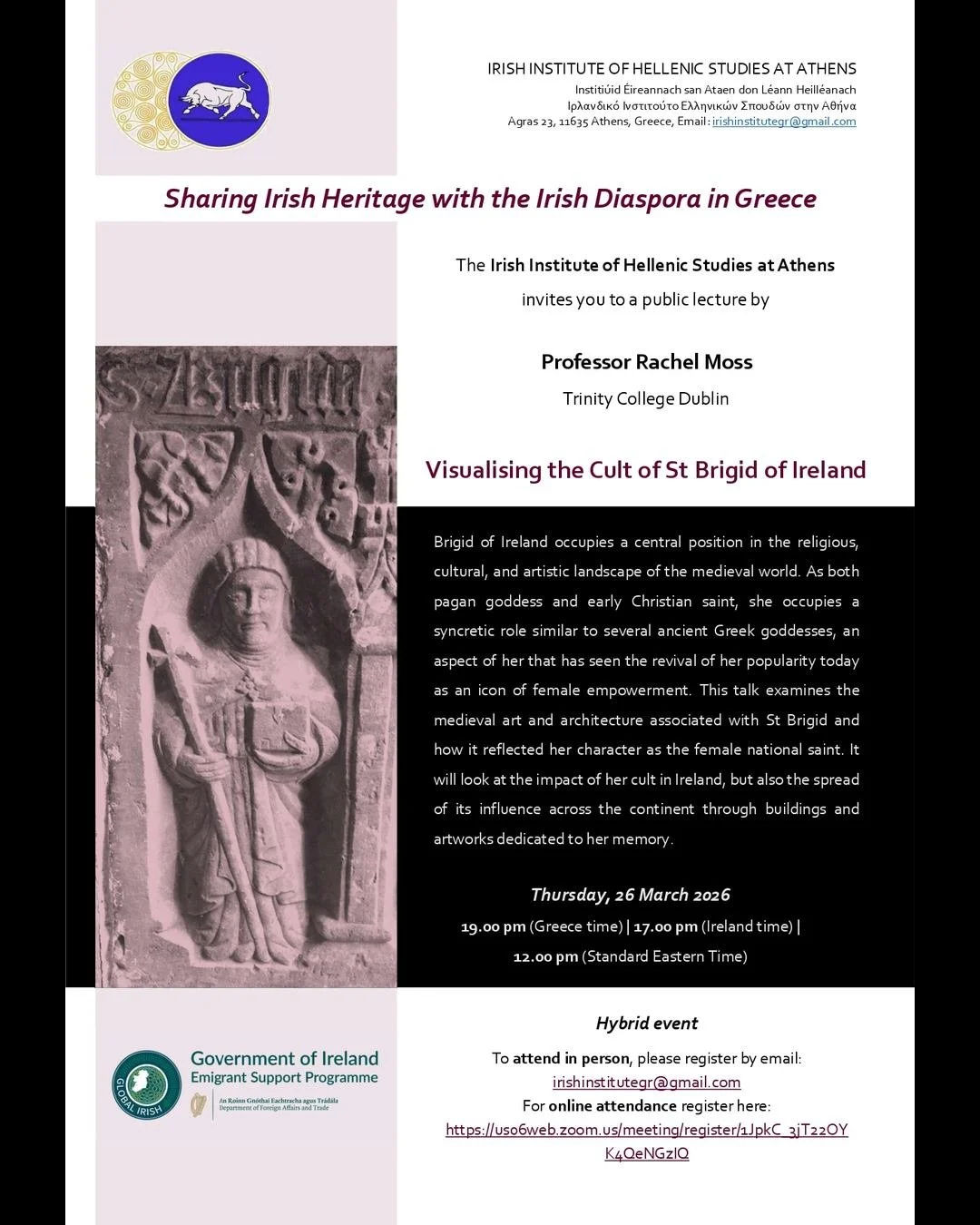
We are delighted to announce the launch our new initiative, “Sharing Ancient Irish Heritage with the Irish Diaspora in Greece.” With the generous support of the Embassy of Ireland in Greece, this new series of public events explores the rich history and culture of Ireland and aims to strengthen cultural ties between the Irish diaspora in Greece and their homeland, while also fostering a deeper interest in Irish heritage among the Greek public.
Our series opens with a lecture by Rachel Moss (Professor in the History of Art and Architecture at Trinity College Dublin) “Visualising the Cult of St Brigid of Ireland” on Thursday 26 March, 2026, 19:00 (Greece) | 17:00 (Ireland) | 12:00 (EST). Hybrid event.
The lecture will be followed by a discussion with the audience and a light wine reception.
To attend in person at our premises (Agras 23), please register by email: irishinstitutegr@gmail.com
For online participation, please register here: https://us06web.zoom.us/.../register/1JpkC_3jT22OYK4QeNGzIQ
We very much look forward to welcoming you
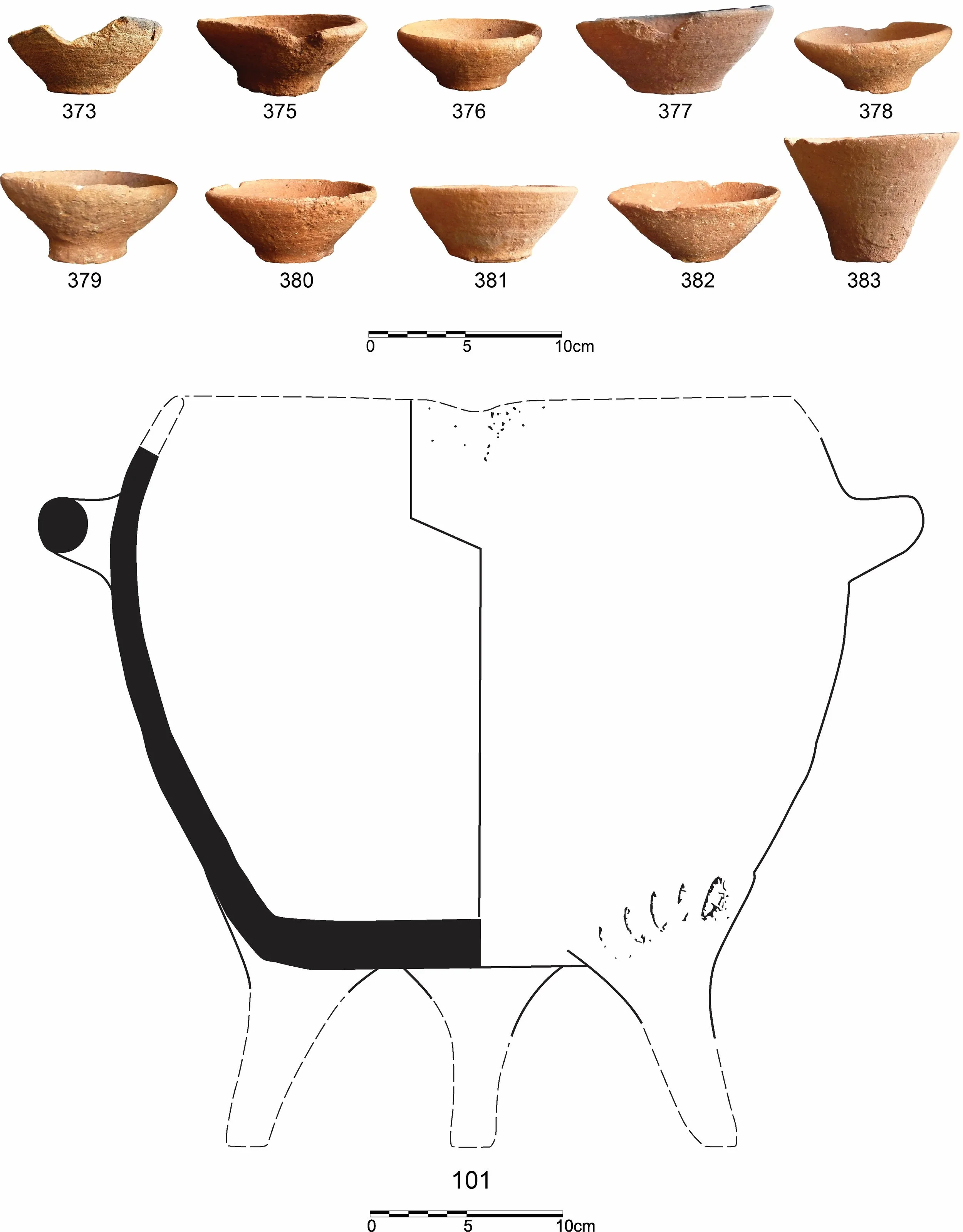
Natalie Abell, Households as hosts? Quantifying cups and cookpots to shed light on commensality at Bronze Age Ayia Irini, Kea
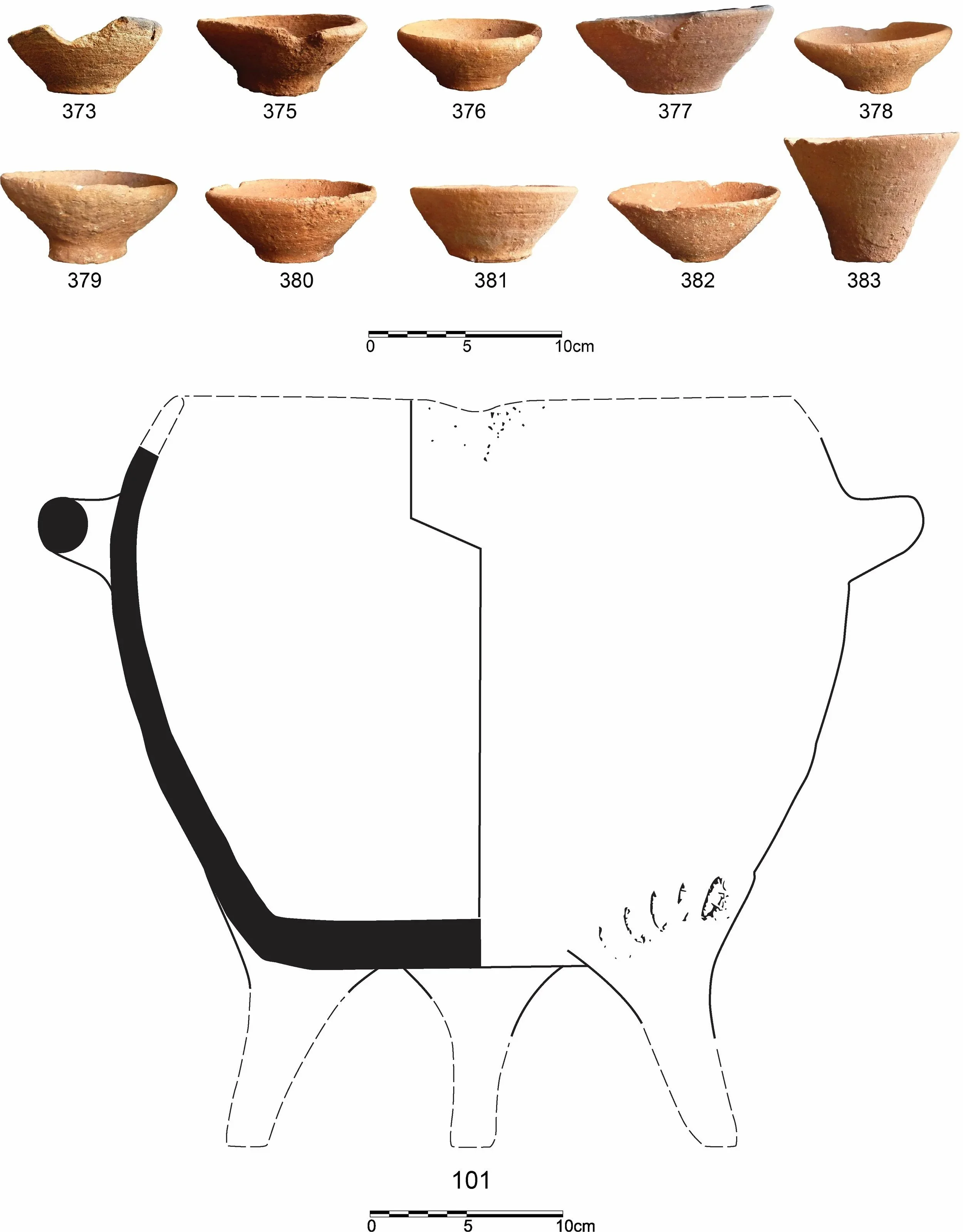
You are invited to an online lecture on Thursday February 19th, 2026 at 19.00 pm (Greek time) 17.00 pm (Ireland time), 12.00 pm (Standard Eastern Time) by Natalie Abell (University of Michigan), ‘Households as hosts? Quantifying cups and cookpots to shed light on commensality at Bronze Age Ayia Irini, Kea.’
Abstract: This study is a team project of Natalie Abell, Jami Baxley Craig, Lauren Alberti, and Christine Weber, presented by Natalie Abell.
A recent re-evaluation of archival excavation documents from Bronze Age Ayia Irini on the Cycladic island of Kea has provided new data for the quantities of cooking and drinking equipment, namely tripod vessels and handleless cups, at the site. These vessels were present in many later MBA and earlier LBA deposits, mostly from in and around houses. Some of these deposits and houses contained very high numbers of handleless cups and/or tripod vessels (hundreds to thousands). These quantities seem to exceed even the most generous interpretation of the daily needs of household inhabitants, especially since the site itself probably housed a population of 500 or fewer people at its maximum extent. Although most studies of commensal activities in the Aegean focus on identifying primary feasting deposits, the evidence from Ayia Irini seems more likely to represent the stockpiling of commensal equipment by individual households for future events. Analysis of the assemblage of tripods and handleless cups from Ayia Irini, therefore, provides a new perspective on how local commensal practices were embedded in household activities, domestic economy, and ritual practice.
Please register here: https://us06web.zoom.us/meeting/register/PH32CjhlT7CAPaWDRabkaQ
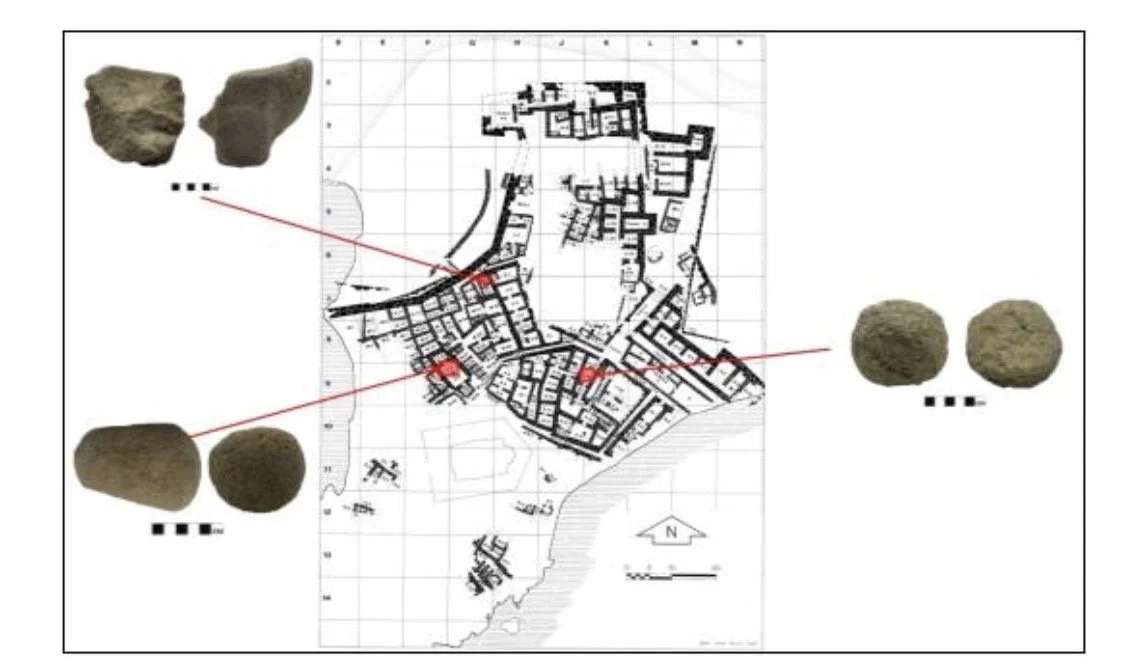
Seminar Series, Domestic Life in the Ancient World: Dr Jami R. Baxley Craig, “Food Processing in Prehistoric Greece: A Perspective from Ground Stone Tool Studies”
You are invited to our 2025-26 Seminar series on ‘Domestic Life in the Ancient World’. This will be an online event on Thursday 12th February, 2026 at 19.00 pm (Greece time), 17.00 pm (Ireland time), 12.00 pm (EST), by Dr Jami R. Baxley Craig (Florida State University), “Food Processing in Prehistoric Greece: A Perspective from Ground Stone Tool Studies”
Abstract: Ground stone tools is one of the largest and most prolific categories of objects that were involved in the production processes of many tasks essential to historic and prehistoric life across the world. The study of this artifact class can help us to answer questions concerning subsistence strategies, trade, craft production, and technology. In the Neolithic and BA Aegean, ground stone tool studies have been particularly integral to our understanding of prehistoric food-processing, especially of Neolithic Greece. Less emphasis, however, has been placed on their appearance at BA sites and their role in craft production activities. This seminar will explore the role of ground stone tools in the processing of foodstuffs and in craft production activities of the prehistoric Aegean using the BA town of Ayia Irini, Kea as a case study. I will especially stress the significant contribution that systematic studies of ground stone tools can provident only for our understanding of subsistence strategies, but also of other embedded social constructs and processes of the prehistoric Aegean.
Further information:
The IIHSA Seminar Series for 2025–2026 will explore various aspects of household life in the ancient world, including labour and production, gender roles, childhood, food practices, and broader issues of social structure and negotiation across different periods and regions. Designed for graduate students and anyone interested in engaging deeply with a topic beyond the traditional lecture format, the series offers participants an opportunity to discuss and exchange ideas directly with experts in the field. Each seminar features a 30–40 minute presentation followed by an open discussion, co-led by the Assistant Director, to encourage active participation and dialogue. A brief bibliography is provided for those who wish to familiarize themselves with the seminar topic.
Bibliography
Adams, J.L. 2013. Ground Stone Analysis. A Technological Approach. Vol. 2.University of Utah Press.
Baxley Craig, J.R. 2025. “Ground Stone Tools Across Houses: A Preliminary Spatial and Contextual Analysis from Ayia Irini, Kea.” JAS: Reports: Anthropological Insights into Ground Stone Tool Technology.
Bekiaris, T., D. Chondrou, I. Ninou, and S.M. Valamoti. 2020. “Food-Processing Ground Stone Tools in the Greek Neolithic and Bronze Age. A Synthesis of the Published Data.” Journal of Greek Archaeology5:135–95.
Georgiadis, M. 2017. “A Synthesis of the Neolithic and Early Bronze Age Ground Stone Tools from the Dodecanese.” In The Archaeological Work in the Aegean Islands, 17–30. Mytilene: Hellenic Ministry of Culture and Tourism.
Rowan, Y.M., and J.R. Ebeling, eds. 2008. New Approaches to Old Stones: Recent Studies of Ground Stone Artifacts. Approaches to Anthropological Archaeology. London; Oakville: Equinox Publishing Ltd.
For online attendance please register here: https://us06web.zoom.us/meeting/register/pcuxVCicSyynlf-2jW5T6A
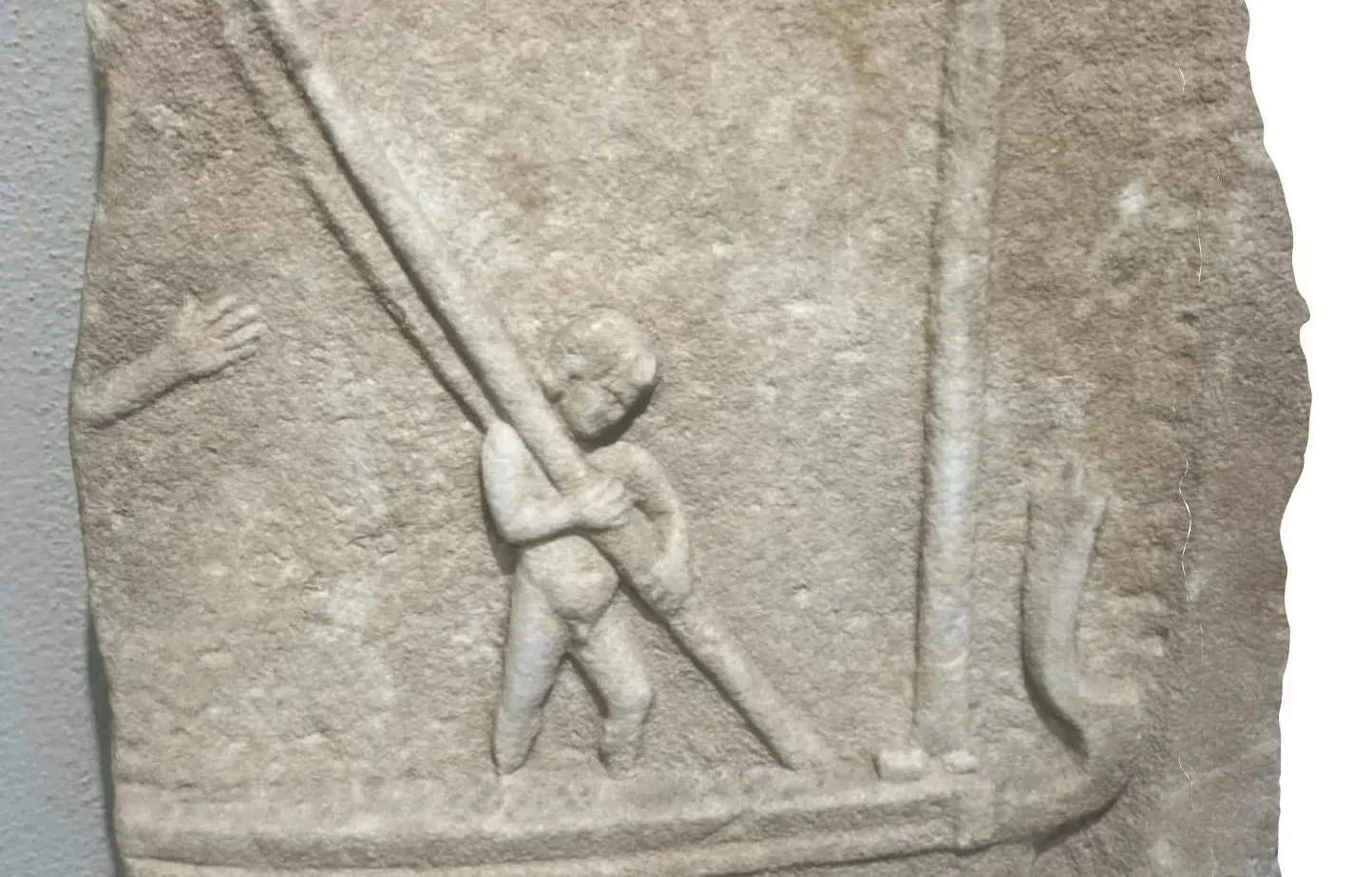
Dermot Grant ‘Illustrating the mobility of cults on trade networks and navigation routes in the central Aegean. Apollo and Artemis as a case study’
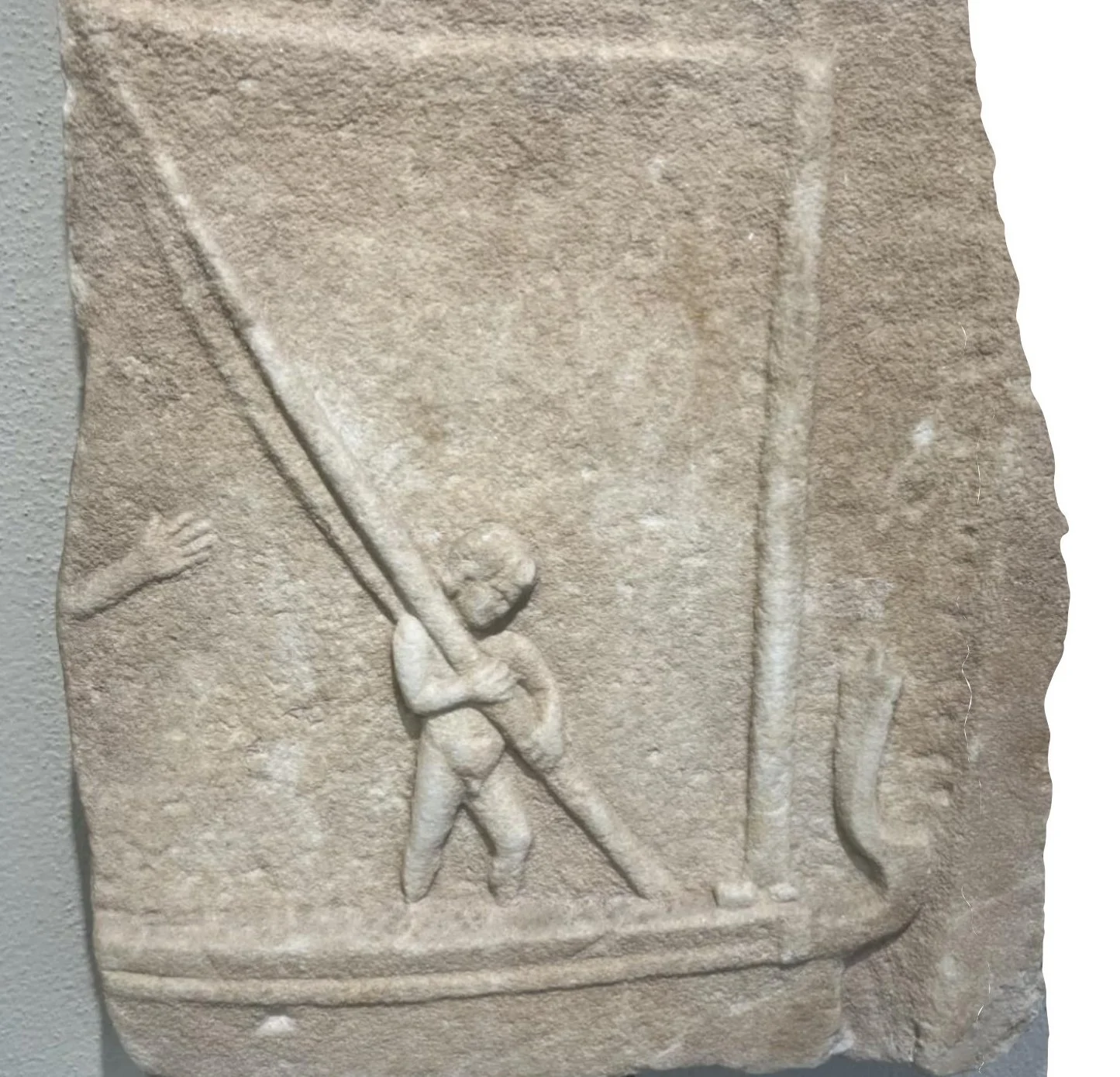
You are invited to an online lecture on Thursday January 15th 2026 at 19.00 pm (Greek time) 17.00 pm (Ireland time), 12.00 pm (Standard Eastern Time) by Dermot Grant (Trinity College Dublin) on Illustrating the mobility of cults on trade networks and navigation routes in the central Aegean. Apollo and Artemis as a case study.
Abstract: Maritime sanctuaries have been described as nodes of ‘seaborne connections supported by always evolving and adapting sets of myth and ritual, moving alongside actual goods and people’ (Kowalzig 2018, 95–95). Apollo and Artemis sanctuaries have a disproportionate presence across the Cyclades and to Chios and north to Skyros and Volos, and Artemis threading its way through the Euboean Gulf, although not necessarily with the same epithets. The diffusion of the Delia cults, with Apollo accompanying Artemis, are often venerated as parallel cults (Angliker 2022, 247). Using Apollo and Artemis sanctuaries in the Central Aegean as a case study, this presentation will attempt to identify the drivers of the mobility of the cults, including trade and navigation networks and within highly connected economic communities.
Cited bibliography
Angliker, E. (2022). Insights into the Cult and Apollo and Artemis at the Parian Sanctuaries. In E. Guillon, A. Latzer-Lasar, S. Lebreton, M. Luaces, F. Porzia, E. Rubens Urciuoli, J. Rupke, & C. Bonnet (eds), Naming and Mapping the Gods in the Ancient Mediterranean (Vol. 1, pp. 247–271). De Gruyter.
Kowalzig, B. (2018). Cults, Cabotage, and Connectivity. In C. Knappet (ed.), Maritime Networks in the Ancient Mediterranean World. Cambridge University Press.
Please register here: https://us06web.zoom.us/meeting/register/V02i2VzqQ_-wmCxyaWkCpw
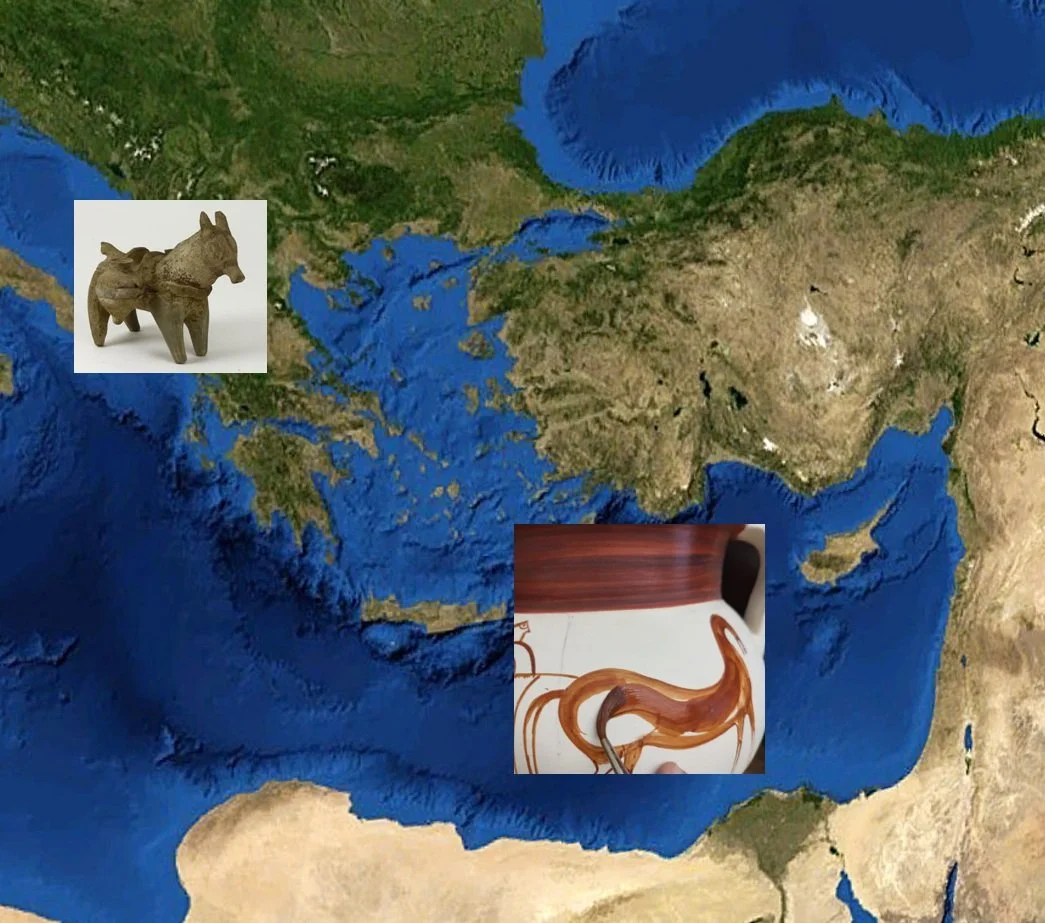
Dr Angelos Papadopoulos, ‘Access and Control: Inequality and Economic Power in the Late Bronze Age Aegean’
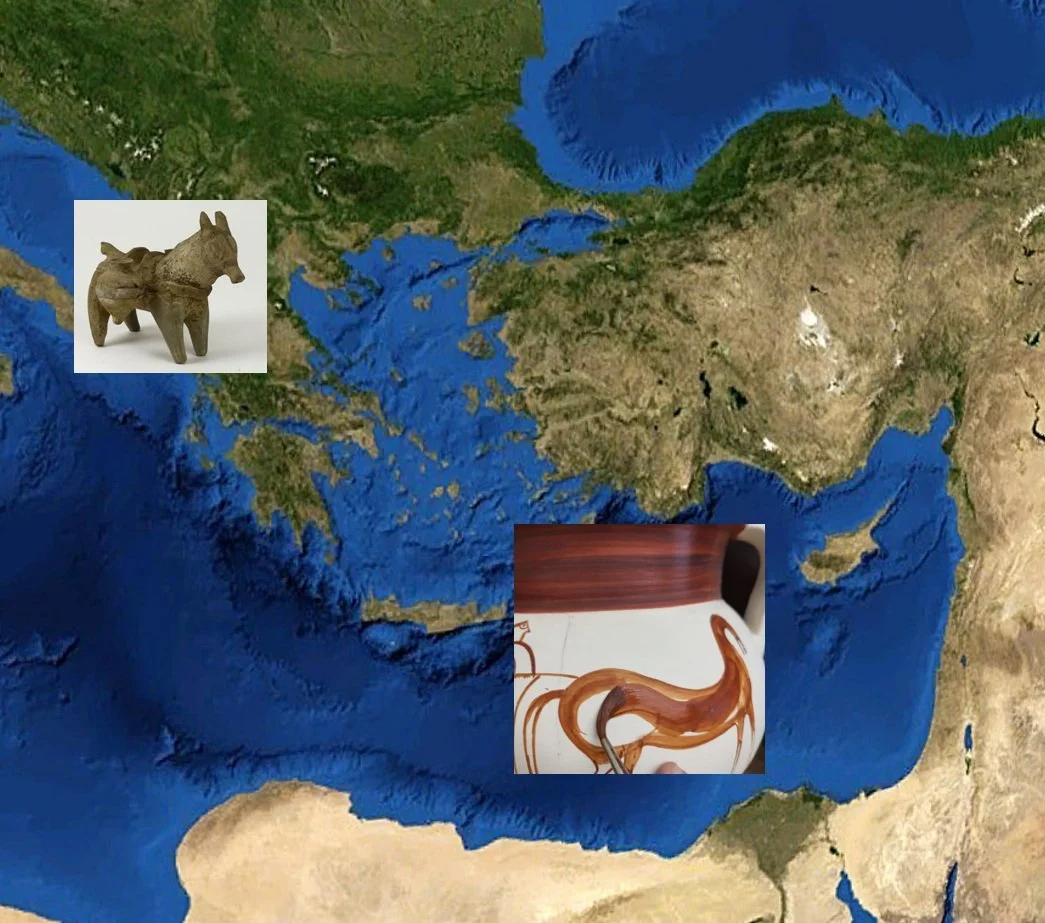
You are invited to a hybrid lecture on Thursday December 11th, 2025 at 19.00 pm (Greek time) 17.00 pm (Ireland time), 12.00 pm (Standard Eastern Time) by Dr Angelos Papadopoulos (College Year at Athens), on ‘Access and Control: Inequality and Economic Power in the Late Bronze Age Aegean’.
Abstract: In discussing Mycenaean trade, James Wright asked how the elites at Mycenae achieved domination (on the mainland and across the Aegean), suggesting that at least part of their power derived from controlling production and distribution. In addition, the idea that social inequality is fundamentally rooted in access to and control over resources forms the basis of this presentation. Here, “resources” include not only cultivable land, water, minerals, metals and clays, but also passages, bridges, safe anchorages and harbours that enabled mobility and exchange. The central hypothesis is that the groups who accessed or extracted these resources were not always the same as those who profited from their distribution. Furthermore, it is proposed that individuals such as merchants or warriors may have operated privately, at times beyond the supervision of state institutions like the palaces, offering an additional layer of inequality within the Late Bronze Age Aegean. Examples from the contemporary Eastern Mediterranean will be used to illustrate these dynamics.
For online attendance register here: https://us06web.zoom.us/meeting/register/6YfAdSI7SgiLkplsuR8pKA
To attend in person, please register by email:irishinstitutegr@gmail.com
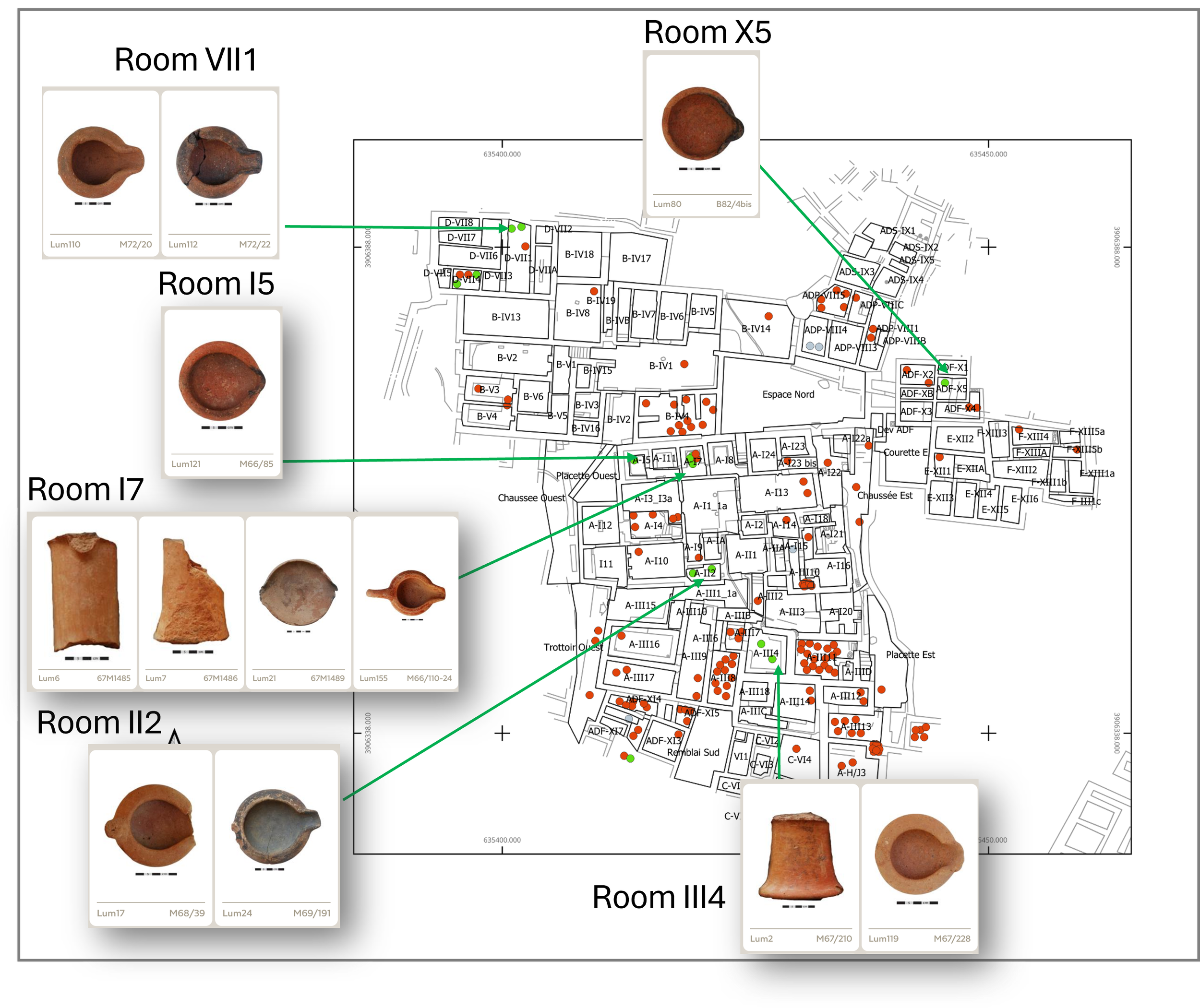
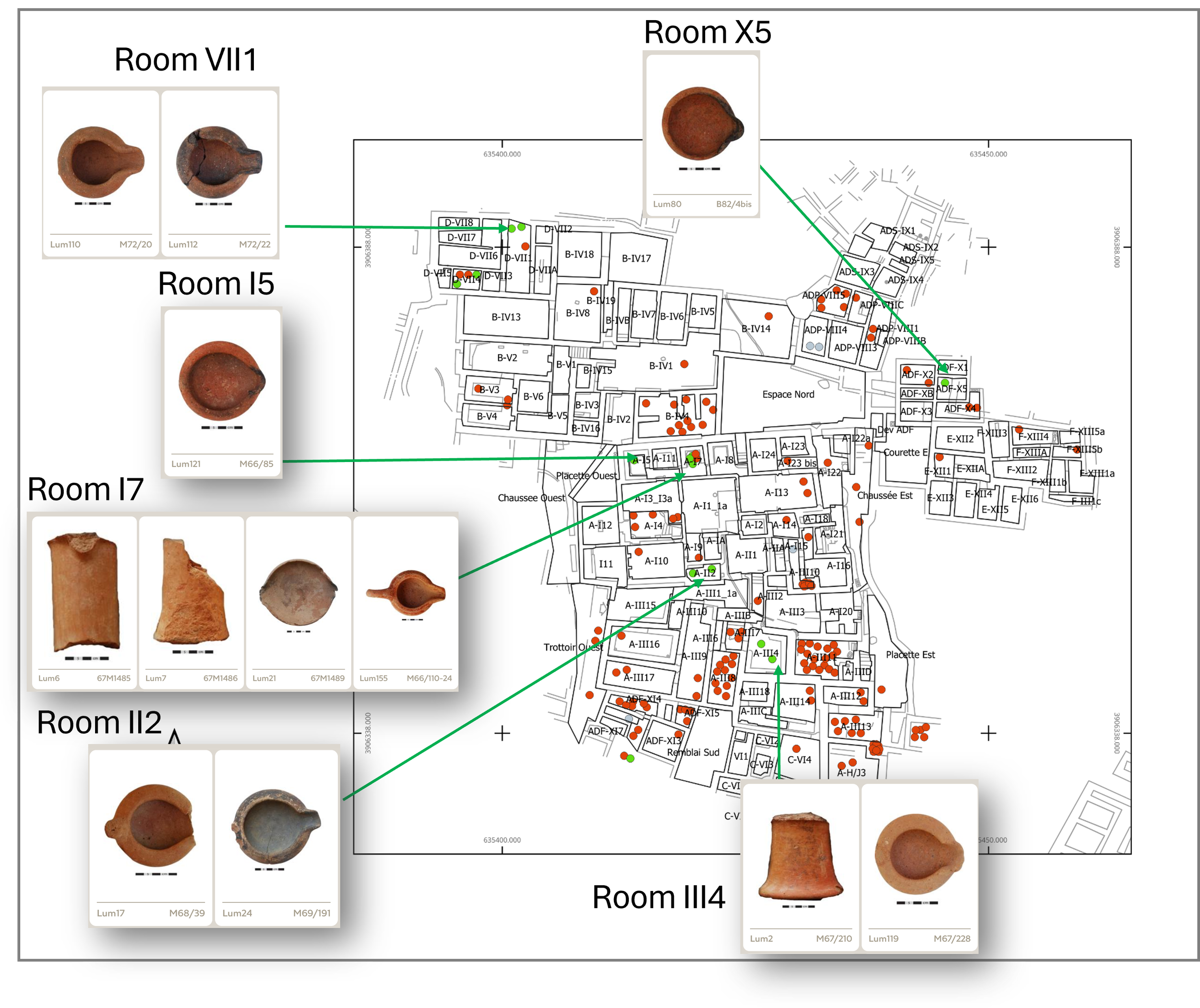
Seminar Series, Domestic Life in the Ancient World: Dr Bastien Rueff, When fire-related utensils reveal the uses of domestic spaces: An Aegean Bronze Age perspective
You are invited to our 2025-26 Seminar series on Domestic Life in the Ancient World. his will be a hybrid event on Thursday 4th December, 2025 at 19.00 pm (Greece time), 17.00 pm (Ireland time), 12.00 pm (EST), by Dr Bastien Rueff, “When fire-related utensils reveal the uses of domestic spaces: An Aegean Bronze Age perspective”. Dr Rueff is a Scientific Member of the French School at Athens.
Abstract: This presentation centres on demonstrating how fire-related utensils can illuminate the uses of domestic spaces in the Aegean Bronze Age. The term fire-related utensils refers to mobile objects, mostly of clay, used for lighting, heating, and perfuming, such as lamps, incense burners, scuttles, braziers, mobile hearths, and fireboxes. These artefacts are considered together as a category because their production appears to have increased with the rise of a palatial system in Crete and the development of urban environments at the beginning of the 2nd millennium BCE. The seminar will focus on two case studies: first, lamps and the question of illumination; and second, fireboxes and the issue of perfume production in domestic contexts. The methodology employed combines the direct study of archaeological material from settlements in Crete and Turkey with contextual and spatial analyses, experimental approaches, lipid analysis, and 3D reconstructions. Through these examples, I aim to shed light on the concept of lived space and to address broader questions, such as how to delineate domestic and craft spaces.
Further information:
The IIHSA Seminar Series for 2025–2026 will explore various aspects of household life in the ancient world, including labour and production, gender roles, childhood, food practices, and broader issues of social structure and negotiation across different periods and regions. Designed for graduate students and anyone interested in engaging deeply with a topic beyond the traditional lecture format, the series offers participants an opportunity to discuss and exchange ideas directly with experts in the field. Each seminar features a 30–40 minute presentation followed by an open discussion, co-led by the Assistant Director, to encourage active participation and dialogue. A brief bibliography is provided for those who wish to familiarize themselves with the seminar topic.
Bibliography
· Bibliography
· Rueff, B. 2019. The organization of space and time in the Quartier Mu of Malia (Crete, Bronze Age, 3200-1100 BC), in light of lamps. Journal of Energy History / Revue d’Histoire de l’Énergie 2. https://doi.org/10.3917/jehrhe.002.0001b.
· Rueff, B. 2024. Macroscopic identification of Minoan lamps’ fuels. An experimental use-alteration and ultraviolet analysis. Journal of Archaeological Science: Reports 54. https://www.sciencedirect.com/science/article/pii/S2352409X24000336. https://doi.org/10.1016/j.jasrep.2024.104405.
· Rueff, B., P. Debels, R. Vargiolu, H. Zahouani & H. Procopiou. 2021. Reading clay vases surfaces: characterization of surface treatments towards functional identification. Journal of Archaeological Science: Reports 38. https://doi.org/10.1016/j.jasrep.2021.103021.
· Rueff, B., A. Pinto, K. Messini & H. Procopiou. 2023. Senses and Activities: A Virtual Reconstruction of the Potter’s Workshop and the North Area of Quartier Mu at Malia (c. 1800-1700 BC). Studies in Digital Heritage 7: 91–112. https://doi.org/10.14434/sdh.v7i2.36158.
· Vandevelde, S., M.Á. Medina-Alcaide, B. Rueff & C. Ferrier. 2024. From fire to light: Illuminating the archaeological past. Journal of Archaeological Science: Reports 55: 104511. https://doi.org/10.1016/j.jasrep.2024.104511.
For online attendance please register here:
https://us06web.zoom.us/meeting/register/uA5WKv87QZW7OeEc0edd9g
To attend in person, please register by email: irishinstitutegr@gmail.com

Seminar Series, Domestic Life in the Ancient World: Dr Kyriaki Tsirtsi, ‘Archaeobotanical insights into everyday life in Classical and Hellenistic Sikyon’

You are invited to our 2025-26 Seminar series on Domestic Life in the Ancient World. This will be a hybrid event on Thursday November 20, 2025 at 7.00 pm (Greek time)/ 5.00 pm (Irish time) / 12.00 (EST) by Dr Kyriaki Tsirtsi on ‘Archaeobotanical insights into everyday life in Classical and Hellenistic Sikyon’. Dr Tsirtsi is a Post-Doctoral Research Fellow in Archaeobotany at the M.H. Wiener Laboratory for Archaeological Science, American School of Classical Studies at Athens.
Abstract: Daily activities related to food production, procurement, storage, and cooking reflect multiple scales of human social organization - from individual household decisions to broader agricultural regimes and ancient economic models. These dynamics can be effectively illuminated through the study of archaeobotanical remains. This paper presents a comprehensive archaeobotanical investigation at the 1st millennium BCE site of Sikyon, aimed at reconstructing aspects of everyday life during the Classical and Hellenistic periods. Through the systematic analysis of both macrobotanical and microbotanical remains recovered from well-contextualized domestic and workshop-related contexts, the study examines patterns of plant exploitation, including acquisition, processing, and consumption. Particular emphasis is placed on the spatial distribution of botanical evidence enabling the reconstruction of intra-household and craft-related organization. By integrating macro- and micro-scale botanical datasets, this research contributes to a deeper understanding of agricultural practices, urban/ agrarian economies, and culinary patterns, while it sheds light on the role of plant-based resources in shaping urban lifeways and socio-economic structures in the north-eastern Peloponnese.
Further information:
The IIHSA Seminar Series for 2025–2026 will explore various aspects of household life in the ancient world, including labour and production, gender roles, childhood, food practices, and broader issues of social structure and negotiation across different periods and regions. Designed for graduate students and anyone interested in engaging deeply with a topic beyond the traditional lecture format, the series offers participants an opportunity to discuss and exchange ideas directly with experts in the field. Each seminar features a 30–40 minute presentation followed by an open discussion, co-led by the Assistant Director, to encourage active participation and dialogue. A brief bibliography is provided for those who wish to familiarize themselves with the seminar topic.
Bibliography
· Douché, C., Tsirtsi, K. and Margaritis, E. 2021. ‘What's new during the 1st millennium BCE in Greece? Archaeobotanical results from Olynthos and Sikyon’. Journal of Archaeological Science, Reports. Vol. 36, 102782.
· Maltas, T., Tsirtsi, K., and Margaritis, E. 2023. ‘Archaeobotanical remains: sampling and processing in the field’. Chapter in edited volume: in E. Margaritis, A. Oikonomou, E. Nikita and T. Rehren (eds.). Field Sampling for Laboratory Analysis in Archaeology. The Cyprus Institute. 2-11.
· Tsirtsi, K., Henkel, C., Garcia-Granero, J-J., Alphas, E., Pilides, D. and Margaritis, E. 2024. ‘Bringing together macro- and micro-botanical remains in Bronze Age Cyprus: The cases of Alambra-Kato Lakkos and Agios Sozomenos-Ampelia’. Journal of Archaeological Science: Reports. Vol. 56, 104554.
· Tsirtsi, K. 2022. Agricultural and Domestic Practices in Classical Sikyon: Evidence from the Archaeobotanical Remains and Utilitarian Pots (Unpublished PhD thesis). The Cyprus Institute. Nicosia. Cyprus
· Zohary, D., Hopf, M. & Weiss, E. 2012. Domestication of Plants in the Old World. Fourth edition. Oxford University Press.
For online attendance please register here:
https://us06web.zoom.us/meeting/register/1IZ9bpqqSLeI5-1YK7YeWA
To attend in person, please register by email: irishinstitutegr@gmail.com

Dr Shannon La Fayette Hogue, ‘Floor Plaster Production Technologies in the Palace of Nestor at Pylos’.
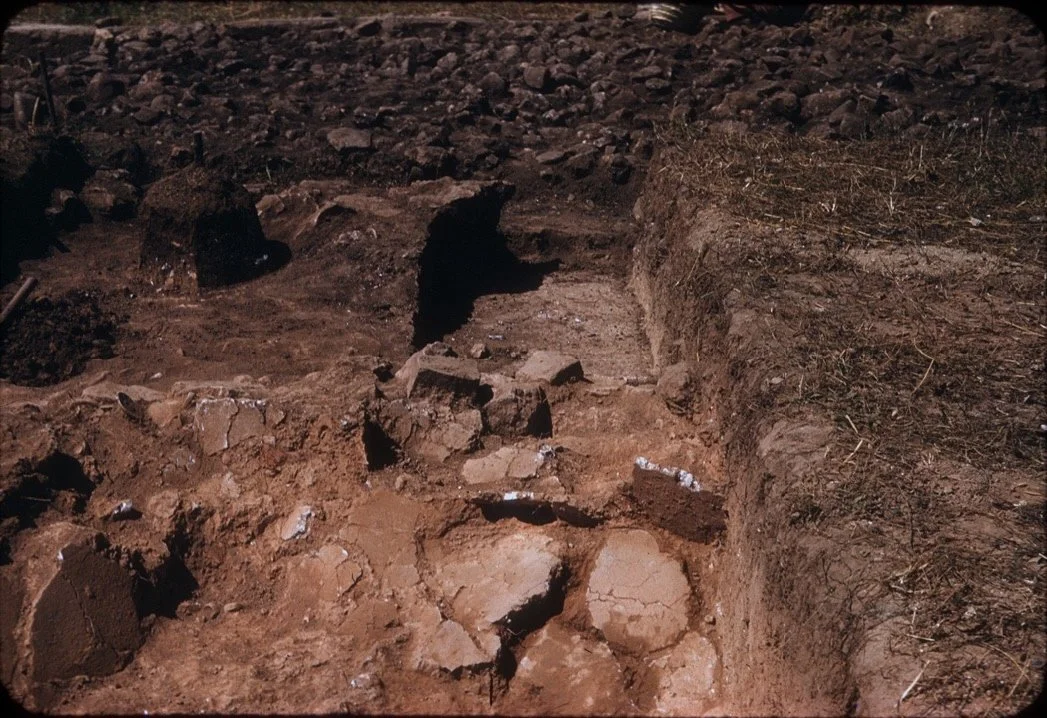
You are invited to an online lecture on Thursday November 13, 2025 at 19.00 pm (Greek time) 17.00 pm (Ireland time), 12.00 pm (Standard Eastern Time) by Dr Shannon LaFayette Hogue on ‘Floor Plaster Production Technologies in the Palace of Nestor at Pylos’.
Abstract: During the 1953 season, while supervising an excavation area in the Main Building of the Late Helladic IIIB Palace of Nestor at Pylos, Marion Rawson encountered substantial evidence of an upper floor collapse. Her documentation of the collapse contexts and collection of the plaster floor fragments that fell from the upper story form the basis for my new analysis of floor plaster production technologies at Pylos. This paper begins with a tour of the Main Building rooms whose excavation Rawson oversaw in 1953 and illustrates her remarkably consistent recording practices regarding the upper floor collapse. It turns then to observations regarding the floor plaster fragments, which on the surface presented a standardized appearance as polished, white pavements. Macroscopic fabric analysis, however, reveals that their internal fabric composition varied. Examples are presented to illustrate how certain fabric variations in the floor plaster indicate different choices made during the plaster production process. Rawson’s instincts to record and retain plain floor plaster yielded a body of evidence that is now contributing
Register here:
https://us06web.zoom.us/meeting/register/DxRTPO-xQAq503gk3NrtEg

Dr. Clare Tuffy, “Passing the Time at Ireland's Ancient Monuments”

You are invited to an online lecture on Thursday October 30th at 7.00 pm (Greek time)/ 5.00 pm (Irish time) / 12.00 (EST) by Dr Claire Cave, on “Passing the Time at Ireland's Ancient Monuments”.
Abstract: There are places in Ireland where you can travel back in time. At some wonderful prehistoric sites, you can share an experience with people who lived over 5000 years ago. You can stand in the same place as our ancient ancestors stood and wait for the same event to happen. If you are inside the burial chambers of Newgrange or Dowth on the shortest days of the year at winter solstice, you can see sunlight enter the dark tombs just as it was planned by those who built the monuments all those millennia ago. If you climb to the top of Carnbane East at Loughcrew to see equinox sunrise at Cairn T, you are repeating the journey of neolithic pilgrims. In this presentation, Clare Tuffy talks about her many years of being at Newgrange for sunrise and Dowth for sunset at winter solstice and Loughcrewat equinox time. She shares what it’s really like to be there and how visitors from all over the world react to these wonderful monuments.
Register here to attend:
https://us06web.zoom.us/meeting/register/SKEwP7eGS7yh9pqQ-x0VPw

Seminar Series, Domestic Life in the Ancient World: Dr. Anastasia Dimoula, Cooking practices & ceramic vessels in northern Greece during the Neolithic & Bronze Age periods (7th-2nd mill. BCE)

You are invited to our 2025-26 Seminar series on Domestic Life in the Ancient World. This will be a hybrid event on Thursday October 23rd at 7.00 pm (Greek time)/ 5.00 pm (Irish time) / 12.00 (EST) by Dr. Anastasia Dimoula (Aristotle University of Thessaloniki), “Cooking practices and ceramic vessels in northern Greece during the Neolithic and Bronze Age periods (7th-2nd millennium BCE)”
Abstract: Ceramic vessels used in cooking practices constitute an effective proxy for exploring change and variability in the technologies and perceptions of foodways. Within the ERC project PlantCult (PI: Prof. S.M. Valamoti),a holistic approach to cooking pottery has been applied, integrating typological study, technological characterisation, use-wear and content analyses, along with experimental investigations. The case study presented here focuses on prehistoric Northern Greece, where systematically examined contexts have provided a comprehensive image of prehistoric everyday and special-occasion activities. The results indicate that cooking vessels share a set of technological attributes linked to thermal performance and use, yet they also exhibit marked variability through time and across regions. This variability reflects intersecting cultural affiliations and context-specific choices, shaped by environmental features, regional factors, as well as ceramic and culinary traditions.
Further information:
The IIHSA Seminar Series for 2025–2026 will explore various aspects of household life in the ancient world, including labour and production, gender roles, childhood, food practices, and broader issues of social structure and negotiation across different periods and regions. Designed for graduate students and anyone interested in engaging deeply with a topic beyond the traditional lecture format, the series offers participants an opportunity to discuss and exchange ideas directly with experts in the field. Each seminar features a 30–40 minute presentation followed by an open discussion, co-led by the Assistant Director, to encourage active participation and dialogue. A brief bibliography is provided for those who wish to familiarize themselves with the seminar topic.
Bibliography
· Dimoula, A., Z. Tsirtsoni, P. Yiouni, I. Stagkidis, M. Ntinou, S. Prevost-Dermarkar, E.Papadopoulou, & S.Μ.Valamoti. (2020) “Experimental Investigation of Ceramic Technology and Plant Food Cooking in Neolithic Northern Greece.” STAR: Science & Technology of Archaeological Research 5 (2): 269–286.
· Dimoula, A., S. Koulidou, Z. Tsirtsoni, E. Standall, O. E. Craig, and S. M. Valamoti. (2022) “Fusion Cuisine in the Shadow of Mount Olympus: An Integrated Study of Middle and Late Bronze Age Cooking Pots.” In Cooking with Plants in Ancient Europe and Beyond: Interdisciplinary Approaches to the Archaeology of Plant Foods, edited by Soultana Maria Valamoti, Anastasia Dimoula, and Maria Ntinou, 257–276. Oxford and Philadelphia: Oxbow Books.
· Lis, B. (2017) “Mycenaean Cooking Pots: Attempt at an Interregional Comparison.” In Ceramics, Cuisine and Culture: The Archaeology and Science of Kitchen Pottery in the Ancient Mediterranean World, edited by Michela Spataro and Alexandra Villing, 155–165. Oxford and Philadelphia: Oxbow Books.
· Morrison, J. E., C. Sofianou, T. M. Brogan, J. Alyounis, and D. Mylona. (2015) “Cooking Up New Perspectives for Late Minoan IB Domestic Activities: An Experimental Approach to Understanding the Possibilities and Probabilities of Using Ancient Cooking Pots.” In Ceramics, Cuisine and Culture: The Archaeology and Science of Kitchen Pottery in the Ancient Mediterranean World, edited by Michela Spataro and Alexandra Villing.
· Valamoti, S. M., A. Dimoula, and M. Ntinou, eds. (2022) Cooking with Plants in Ancient Europe and Beyond: Interdisciplinary Approaches to the Archaeology of Plant Foods.
For online attendance please register here:
https://us06web.zoom.us/meeting/register/dLbwEHwsShWkE92cLhVspQ
To attend in person, please register by email: irishinstitutegr@gmail.com

IIHSA Open Meeting 2025 and Annual lecture: the Work of the Institute and Dr Christina Souyoudzoglou-Haywood, 'The Archaeology of the Ionian Islands in the Bronze and Early Iron Ages - 25 Years On’

We cordially invite you to the 2025 Annual Open Meeting of the Irish Institute of Hellenic Studies at Athens.
The Director, Professor Joanne Murphy, will present the work of the Institute 2024-2025, followed by a lecture by Dr Christina Souyoudzoglou-Haywood, entitled 'The Archaeology of the Ionian Islands in the Bronze and Early Iron Ages – 25 Years On' to mark the publication of the second edition of her book, 'The Ionian Islands in the Bronze Age and Early Iron Age'.
The event will be hybrid at 19.00 pm (Greece time), 17.00 pm (Ireland time), 12.00 pm (Standard eastern time)
For online attendance register here:
https://us05web.zoom.us/meeting/register/vav4VQzLQAay9sd-rjtQlQ
To attend in person, please register by email: irishinstitutegr@gmail.com
Email us for any further information: irishinstitutegr@gmail.com

Cultural Heritage Management Seminar Series 9: Eleanor Neil, Posthumanism and Community Archaeology in a Contested Landscape

You are invited to our Cultural Heritage Management Seminar Series 9. This online talk on May 22, 2025 at 7.00 pm (EET), 5 pm (Irish time), 12 pm (EST) is given by Dr Eleanor Neil (Aarhus Unversity, Centre for Urban Network Evolutions ) on "Posthumanism and Community Archaeology in a Contested Landscape".
Abstract
Posthumanism challenges traditional, hierarchical, and anthropocentric structures by emphasizing relationality, multivocality, and the agency of both human and nonhuman actors. In a community archaeology context, this means moving away from rigid distinctions between experts and non-experts and acknowledging the active role of landscapes, material culture, and heritage in shaping social identities.A key contribution of posthumanist community archaeology is its ability to break down binary thinking—such as expert/non-expert, past/present, and human/nonhuman—to create more fluid, participatory models of archaeological practice and interpretation.
Within definitions and conceptions of community archaeology, much ink has been spilled on what is classified as archaeology. Does non-invasive survey count? What about museum curation? Do artistic responses have a role to play? These are all valuable and creative responses to the problem of engagement. Much less effort, however, has been spent defining what constitutes a community and how that definition should be approached.
In contested landscapes like Cyprus—where divisions persist due to political conflict and contested heritage claims—the questions around defining communities become particularly thorny. It is in this context that approaches such as posthumanism, with their reimagination of hierarchical definitions, are particularly relevant. By embracing multivocality and co-creation, posthumanist approaches can help reimagine archaeology as a collaborative, socially transformative practice that acknowledges historical trauma while seeking pathways toward shared understanding and co-creation.
Author bio
Dr. Eleanor Q. Neil completed her doctoral research at Trinity College Dublin last year, examining community archaeology in Cyprus. She has wide ranging research interests that include digital methods for community engagement, cultural policy, and the historiography of archaeology. Currently she is employed by Aarhus University’s Centre for Urban Network Evolutions (Denmark), exploring archival and legacy data from 19th- and 20th-century archaeological missions in the Near East.
Registration details: https://www.eventbrite.com/e/1341761858839
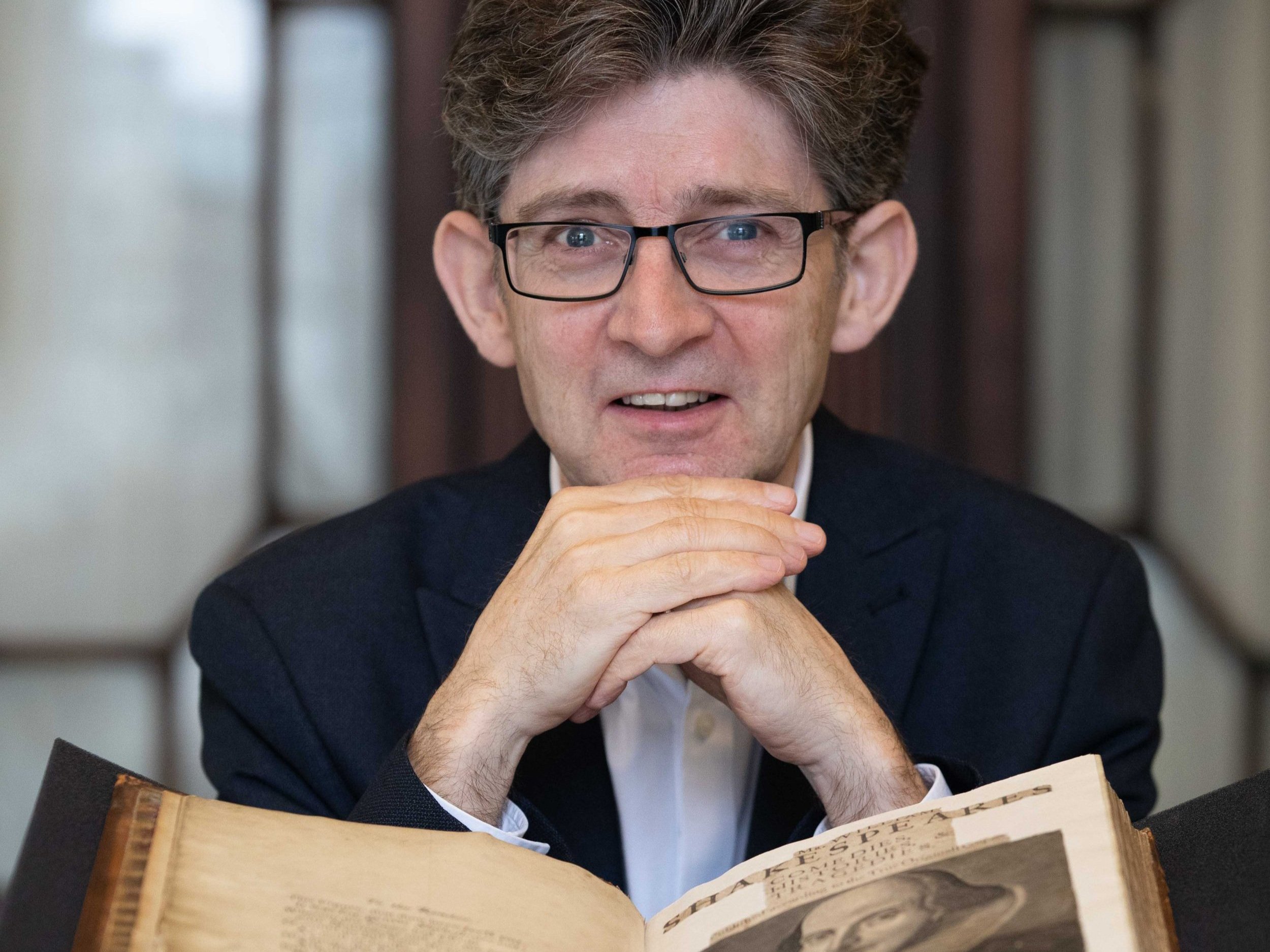
Cultural Heritage Management Seminar Series 8:Andy Murphy, Shakespeare and the Construction of Culture in Eighteenth-century Dublin

You are invited to our Cultural Heritage Management Seminar Series 8. This online talk on April 10 2025 at 7.00 pm (Greek time), 5 pm (Irish time) is given by Professor Andy Murphy (School of English, Trinity College Dublin) on "Shakespeare and the Construction of Culture in Eighteenth-century Dublin",
Registration information coming soon.
Abstract:
In 1762, James Caulfeild, the first Earl of Charlemont, commissioned a grand new house in central Dublin. Charlemont House was one of the jewels of eighteenth-century Irish architecture, but, for Caulfeild, the core of the building was an extensive library at the rear of the property, which ultimately would hold more than 8,000 books and manuscripts. The establishment of the library can be seen as being part of an attempt on Caulfeild’s part to establish a centre of culture in Ireland. One of the jewels in the crown of the collection was a set of early Shakespeare editions – including a fine copy of the 1623 First Folio -- which Charlemont acquired with the help of the noted London-based Irish Shakespearean, Edmond Malone. This seminar will track the history of the Charlemont library, noting the way in which Caulfeild’s project was driven by Enlightenment ideas and the politics of the contemporary Patriot movement.
Registration details: https://www.eventbrite.com/e/cultural-heritage-management-seminar-series-8-tickets-1307937549419
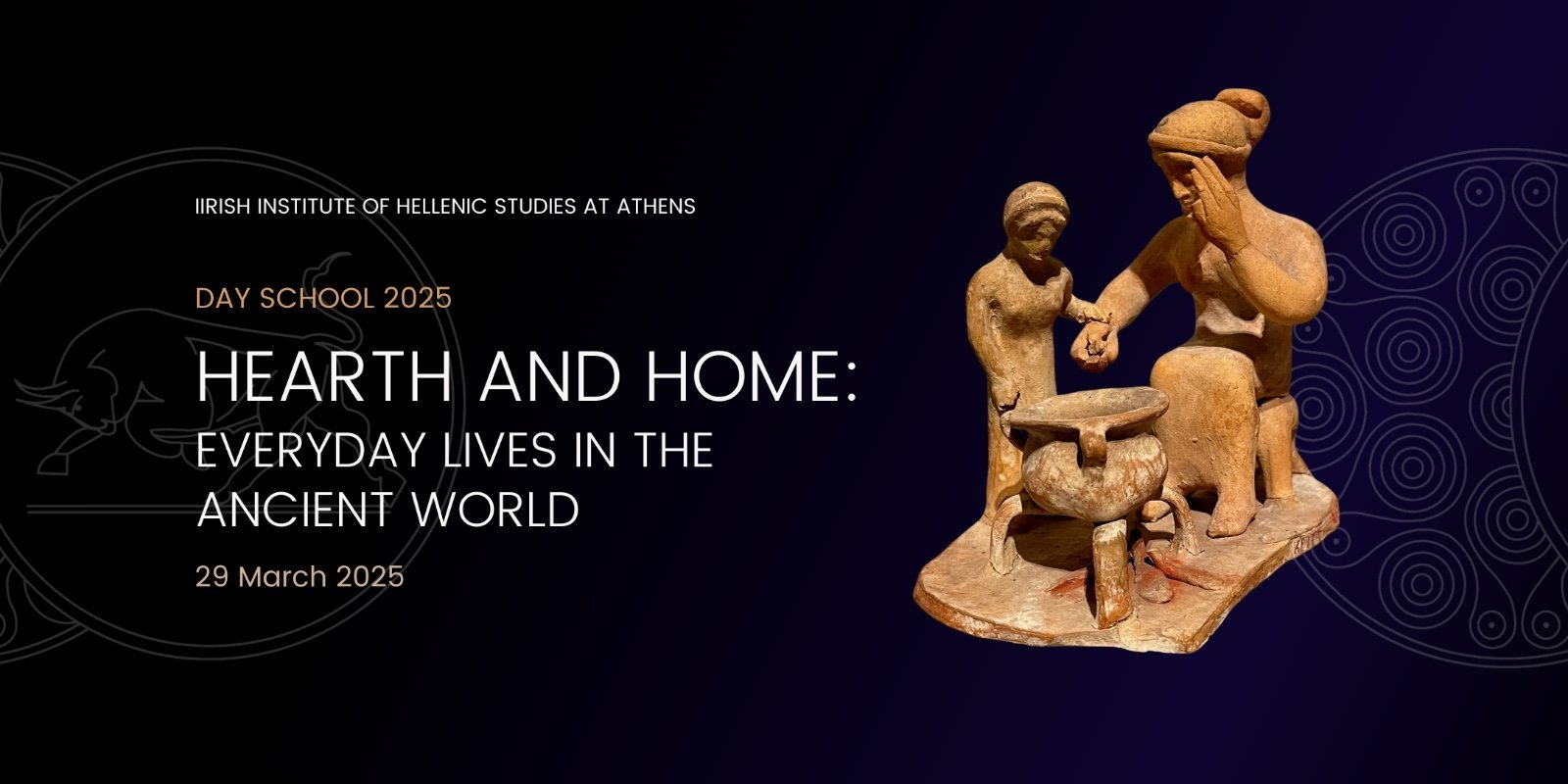
Hearth and Home: everyday lives in the ancient world. Dublin Day School 2025
IIHSA Dublin Day School 2025
Hearth and Home: everyday lives in the ancient world
We invite you to join our Day School on Saturday March 29 2025 at 13:00 (Dublin time) at the Trinity Long Room Hub. Join us in person or online (booking details below)
Exploration of the evidence for ordinary, everyday life can offer a powerful window for engaging and empathising with people in the past. What were their homes like? What do we know about some of the daily rhythms of life such as cooking and eating? And, if away from home, how did families keep in touch. Our 2025 Day School addresses these and other questions using case studies from across the Mediterranean and showcasing textual, archaeological and artistic evidence.
Programme
1 - 1.15: Registration and Welcome
1.15 - 1.45: Philip de Souza (UCD Classics)
The 'ins' and 'outs' of an ancient Greek oikos
1.45 - 2.15: Barry Molloy (UCD Archaeology)
Houses and families at the beginning of the Bronze Age in Crete: A view from the IIHSA excavations at Priniatikos Pyrgos
2.15 - 2.45: Amy O'Keeffe (TCD Classics)
Momma's in the Kitchen: Depictions of Bread and Baking in the Archaeology of Ancient Greece.
2.45 - 3.15 Coffee Break
3.15 - 3.45: Alastair Daly (TCD Classics)
Pots and Pans: Household Objects in Greek Comedy
3.45 - 4.15: Marc Martucci Morris (UCD Archaeology)
Messapian Home Cooking: Everyday Meals at the Crossroads of the Greco-Roman World.
4.15 - 4.45: Anna Chahoud (TCD Classics)
Home Abroad: Letters as documents of everyday life at the periphery of the Roman empire
Followed by a small reception sponsored by Odaios Foods
Organised by the Irish Institute of Hellenic Studies at Athens in co-operation with the Department of Classics, Trinity College Dublin, and kindly hosted by the Trinity Long Room Hub.
Please reserve an in person place:
https://www.eventbrite.ie/e/hearth-and-home-everyday-lives-in-the-ancient-world-tickets-1266594762029
or register to join us online:
https://tcd-ie.zoom.us/meeting/register/uIekK8y0TeqDJ993m-UPpw

Cultural Heritage Management Seminar Series 7: Adam Behan, Irish Popular Music, Cultural Heritage, & the Institutionalisation of Rock Music in the 1970s

You are invited to our Cultural Heritage Management Seminar Series 7. This online talk on March 20 2025 at 7.00 pm (Greek time), 5 pm (Irish time) is given by Dr Adam Behan (Maynooth University), Irish Popular Music, Cultural Heritage, & the Institutionalisation of Rock Music in the 1970s. Registration information below.
Abstract: Though it is a relatively recent phenomenon, popular music has already become part of the processes of cultural preservation and national heritage-making in Ireland, often for commercial ends and tourist appeal. But of the many kinds of popular music that should be part of these efforts, it is rock music that is usually the focus of attention. Taking this problem as a point of departure, in this paper I examine the entanglement of Irish rock culture with the country’s emerging domestic music industry in the late 1970s, especially in terms of the founding of Hot Press (Ireland’s longest running, most prominent music magazine), the launch of RTÉ Radio 2, and the growing university gig circuit, out of which many of the most influential managers and promoters emerged. I argue that these developments involved a larger process of the institutionalisation of rock music in Ireland, one that has implications for which kinds of Irish popular music are readily remembered, valued and considered worth commemorating in terms of the nation’s heritage. Though I leave open the question of how Irish popular music should best be conserved going forward, I argue that only by grappling with this historical problem of institutionalisation can we begin instead to formulate an approach that is diverse in its inclusion of genres and subcultures, many of which are precarious and always at risk of disappearance.
Biography Adam Behan is a musicologist who works on western music in the twentieth century, both classical and popular. He holds degrees from Trinity College Dublin and the University of Cambridge, and is currently an IRC Postdoctoral Research Fellow at Maynooth University, where he is writing a book about Irish popular music at the end of the twentieth century. His research has won awards including the Karl Geiringer Scholarship from the American Brahms Society and the Westrup Prize from the Music & Letters Trust. He is a member of the SMI Council and his work appears in several journals, including Music Analysis, Twentieth-Century Music, Music & Letters, and the Journal of the Royal Musical Association.
To register for the seminar online: https://www.eventbrite.com/e/iihsa-culture-heritage-management-seminar-series-7-tickets-1280548648479

Dr Giorgos Papantoniou, Landscape Archaeology and Social Transformations: Voices from Cyprus

You are invited to a hybrid lecture (online and at the IIHSA premises in Athens) on Thursday March 6th 2025 at 7.00 pm (Greek time) by Dr Giorgos Papantoniou (Trinity College Dublin) on ‘Landscape Archaeology and Social Transformations: Voices from Cyprus.’
Abstract: A holistic approach to landscape archaeology considers ‘landscape’ as an expression of society within a system of cultural meaning; it gives equal consideration to built and natural environments, as well as humans and movable objects, seeking to ‘read’ place-making and materialisation of ideologies. This paper, using Cyprus as a case-study, aims to raise issues for discussion about the changes in the use and concept of sacred landscapes as developed in the Archaic and Classical periods under the Cypriot kings (the basileis), but then continued to function in a new imperial environment, that of the rule of the Ptolemaic strategos and later of the Roman proconsul. This diachronic, inter-disciplinary and Cypro-centric approach reveals that the new politico-economic Hellenistic and Roman structures were, as in the preceding periods, supported by the construction of symbolically charged sacred landscapes. Thus, during the long history of the island, we may identify three pivotal phases: first the consolidation of the Cypriot polities and the establishment of a ‘full’ sacred landscape as shown by the rise of the number of urban and extra-urban sanctuaries; then the transition from segmented to unitary administration under Ptolemaic and Roman imperial rule and the consolidation of a more ‘unified sacred landscape’; finally, as a conclusion, the establishment of a number of Christian bishoprics on the island and the movement back to a ‘full’ sacred landscape as shown by the establishment of a great number of urban and extra-urban basilicas.Case-studies will also be drawn from the archaeological surface survey project in the Xeros River Valley in Larnaka, where we have recently combined landscape, historical and community archaeology to address issues related to contemporary cultural heritage and societal transformations, such as healing of negative memories and contribute to various communities’ wellbeing. Moving beyond the particular example of Cyprus, this contribution offers a paradigm for the implications that the employment of the ‘sacred landscapes’ concept may have when addressing issues of socio-political and socio-economic transformations.
Please reserve an in person place:
https://www.eventbrite.com/e/iihsa-lecture-tickets-1262454628779?aff=oddtdtcreator
or register to join us online:
https://tcd-ie.zoom.us/meeting/register/VhOTsAsFS7uttQrz0w66Iw

Dr Giota Barlagianni, ‘Death and Ritual in the Ubaid Period: Social Perspectives on Mortuary Practices in 5th Millennium B.C. Mesopotamia.’
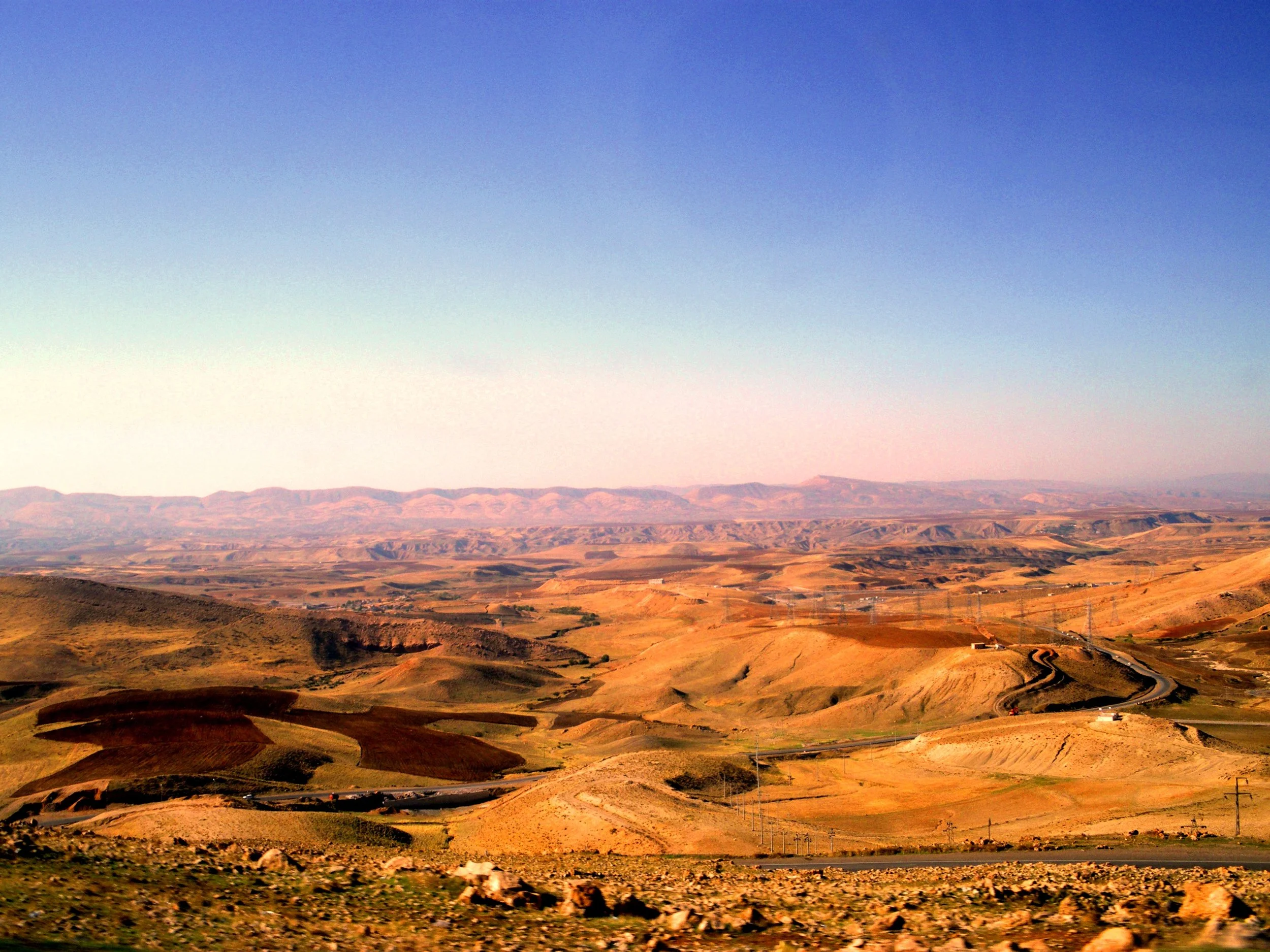
You are invited to an in person lecture at the IIHSA premises in Athens on February 20 2025 at 7.00 pm (Greek time) by Dr Giota Barlagianni, ‘Death and Ritual in the Ubaid Period: Social Perspectives on Mortuary Practices in 5th Millennium B.C. Mesopotamia.’
The archaeological evidence related to the material assemblage of the Ubaid culture remains elusive in determining whether its spread was due to expansion or colonisation without a centralised authority. The Ubaid culture lasted approximately 2 millennia (from 6500 to 4900 BCE) and eventually spread from southern Mesopotamia to a vast area including Saudi Arabia, northern Mesopotamia, northern Syria, southern Anatolia and western Iran. However, the notable shortage of prestige goods and raw materials, as well as the poor burial offerings, suggest that Ubaid communities were largely unstratified. It was only at the end of this period that crystallized mortuary practices began to emerge, with some examples of differentiation in burial contexts. A closer examination of the Ubaid ritual reveals how death was viewed and dealt with, and how this concept developed in the ever-expanding society. The diversity of funerary customs in this period reflects a shift towards more complex social structures. In this context, ancestor worship emerged and burial ceremonies became increasingly elaborate.

Dr Georgios Doudalis, A Last Time Together: Understanding Social Behaviors in Times of Peril at Mochlos during the LM IB period.
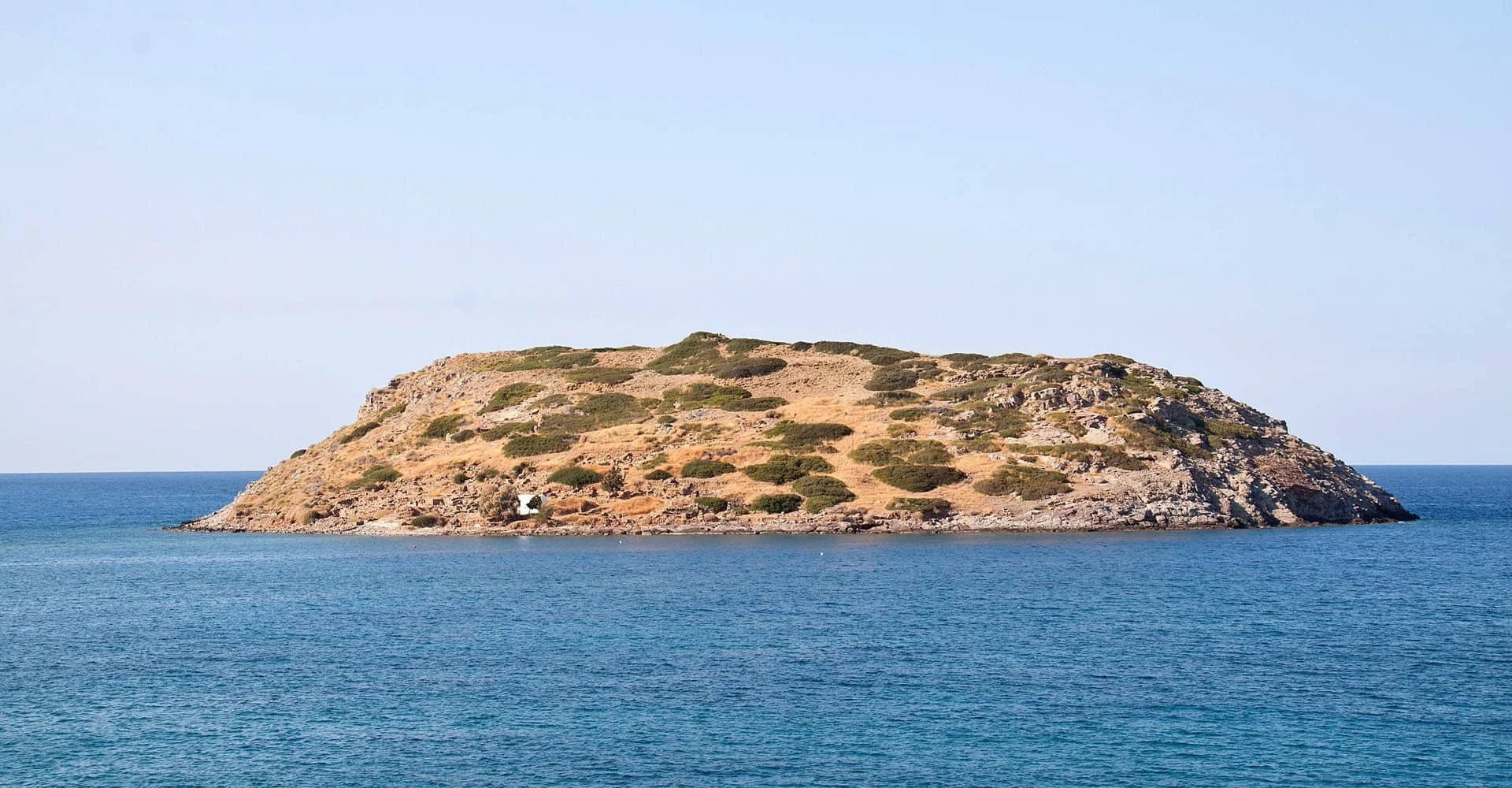
You are invited to an IIHSA Lecture (online) on Friday January 31st 2025 at 7.00 pm (Greek time)/ 5.00 pm (Irish time) / 12.00 (EST) by Dr Georgios Doudalis (University of North Carolina, Greensboro), ‘A Last Time Together: Understanding Social Behaviors in Times of Peril at Mochlos during the LM IB period.’
The settlement at Mochlos stands out for its distinct chronological phases spanning from the Early Bronze Age to the Hellenistic period. This extensive period of occupation is marked by building, rebuilding, expanding, or shrinking of the settlement, due to natural causes (earthquakes?) or human interference. At the end of the LM IB, Mochlos seems to face such destruction. The question I will respond to is: Do we have evidence of communal behavior before such abandonments? And how these could be explained through the examination of the material culture? In this spectrum, I will examine the so-called “closure” ceramic deposits from the Ramp, the South Terrace of the Ceremonial Building B.2, and the material from the “Theatral Area” and the adjacent rooms. Then, I will tangle with ideas about the maintenance of social distinctions in times of peril and the preservation of communal identity through ancestor worshipping as it is expressed through material and space choice.
Registration: https://www.eventbrite.com/e/1216240009609?aff=oddtdtcreator
If the event appears to be sold out, please contact us at irishinstitutegr@gmail.com and we will provide you with the Zoom link.

Eva Andronikidou: The archaeological site in its natural context: natural and cultural diachronic processes

You are invited to an IIHSA Lecture (in person) on Thursday December 19, 2024 at 7.00 pm (Greek time) by Eva Andronikidou (National Technical University of Athens), The archaeological site in its natural context: natural and cultural diachronic processes
Abstract
This work seeks to research the way the archaeological site relates with its natural context and how this relation has evolved through time, from a designer’s point of view.
The relation of man with nature has changed radically in the last years. This relation is clearly expressed in the way man creates space. Architect and urbanist Dimitris Pikionis describes civilization as the creation that was built when man was called to respond to nature: the difficulties, the needs, the opportunities. Every civilization was dictated by nature (Pikionis, 2014: 55-57). The human constructions on earth, are transitional objects between man and nature.
An archaeological site is a fragment of a past reality in the modern world. A contemporary visitor without a relevant background can hardly understand its function or perceive how it originally looked,
especially in places where the environment has changed dramatically, either because it has converted into a modern metropolis, or because of changes in the natural landscape. The design of historical landscapes, when it results from the collaboration of Archaeology with other scientific fields, depending on the case, can lead to a deeper understanding, through the spatial experience of visiting and touring. That said, the purpose of this interdisciplinary research is to investigate methodologies and production of material that can be used as a basis for a design proposal of an architectural synthesis of an archaeological site.